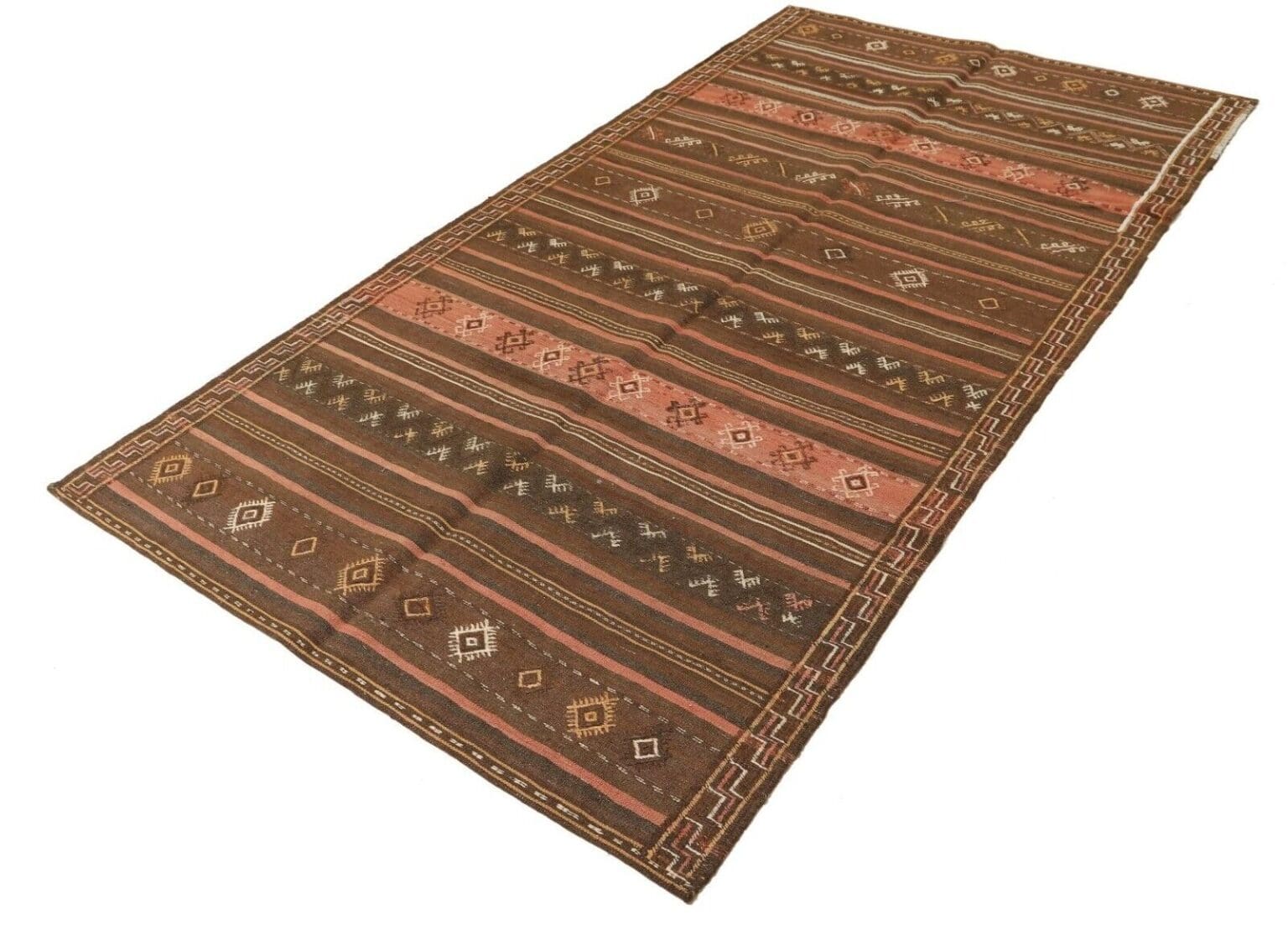
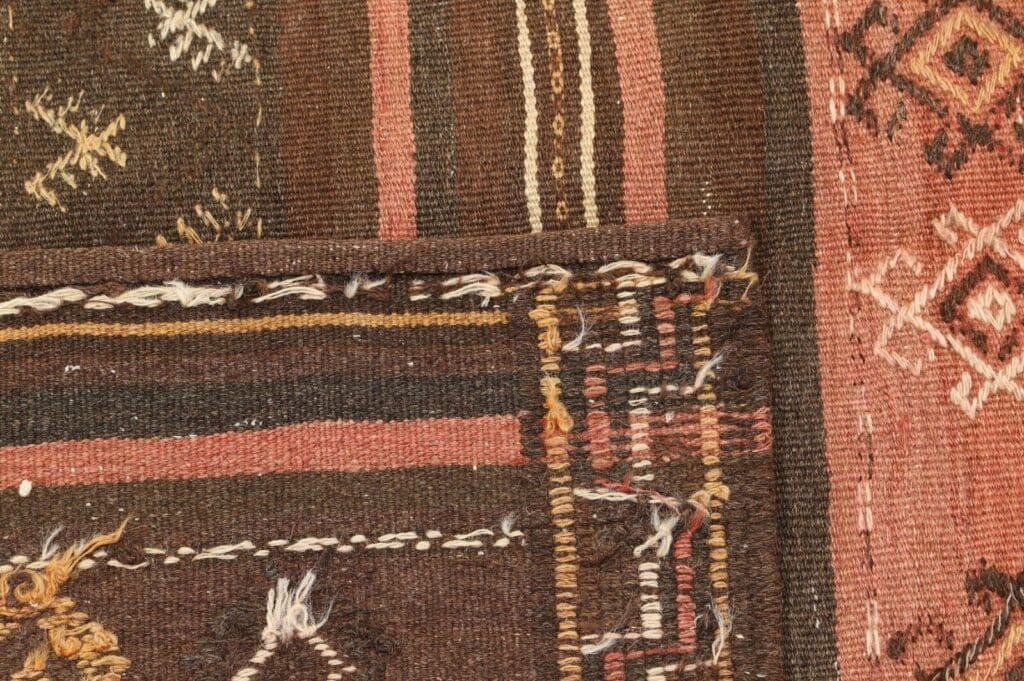
This Oriental rug is described as a hand-woven wool Kilim. A Kilim is made by weaving rather than by tying individual pile knots. The warp provides the supporting structure, while the weft is inserted in coloured sections and compacted to form a flat textile surface. This construction gives a Kilim a different appearance and feel from a conventional high-pile rug. The woven technique is therefore a defining part of this individual piece.
Wool is a traditional fibre for woven Oriental rugs. It can be spun in different yarn weights and accepts colour in a way that gives the finished surface a distinct textile character. A hand-woven rug may show slight variations in thread tension, weaving rhythm and the edges of pattern areas. Such variations arise from the making process and distinguish a hand-crafted one-off from a mechanically uniform product. Here, the material is stated as wool and the technique as hand-woven.
The product description identifies this rug as abrasion-resistant, non-slip and dirt-repellent. It also describes the piece as eco-friendly. These are listed characteristics of the rug offered here. The flat construction of a Kilim allows the design to remain directly visible across the woven surface, while the wool gives the textile a substantial, tactile quality. The combination of wool and hand weaving links a traditional textile method with a practical rug surface.
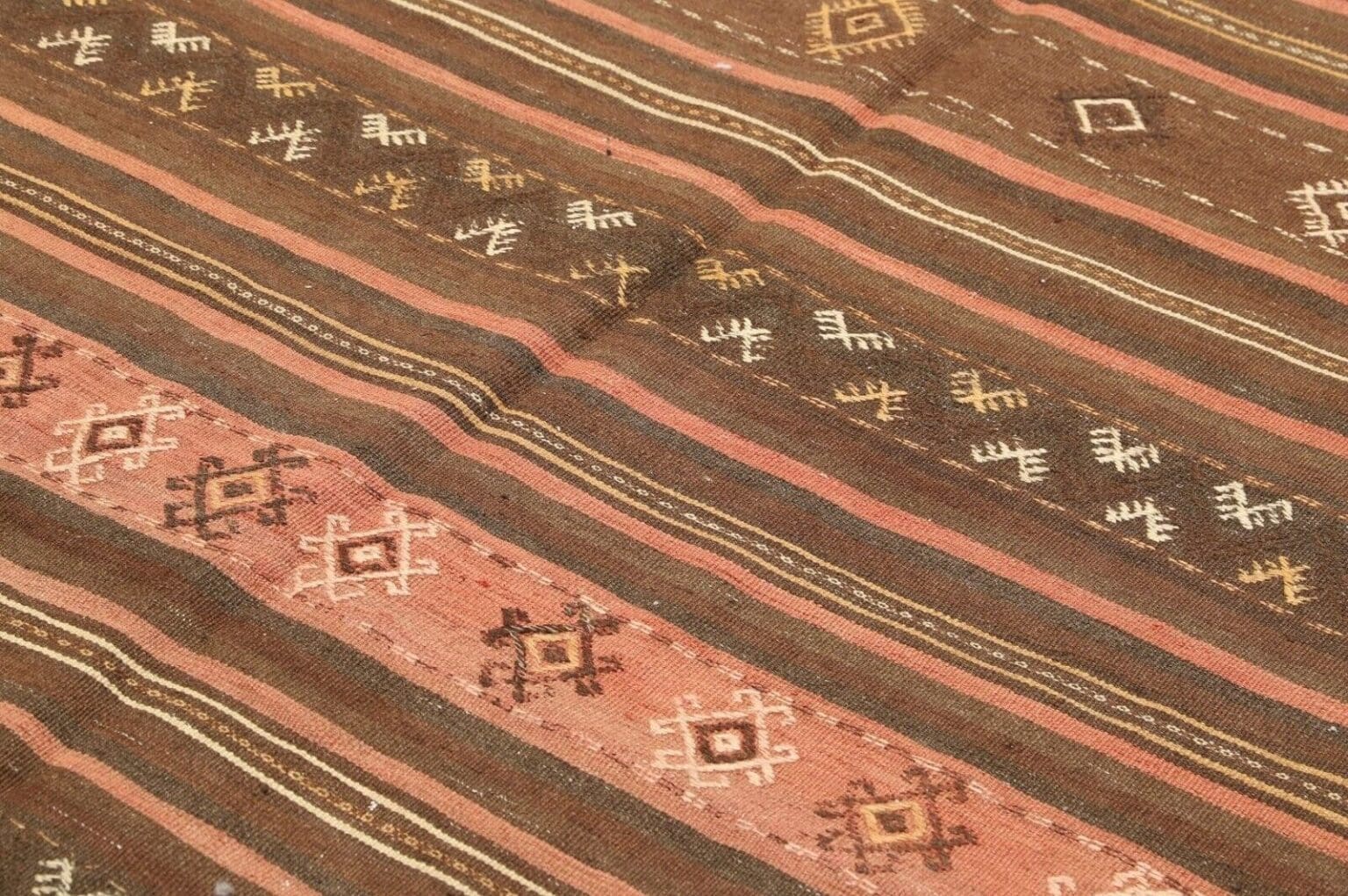
In a Kilim, the pattern is built into the fabric as the weaving progresses. Coloured weft yarns are worked through the warp in separate areas, and the threads are pressed together to close the surface. The appearance is consequently created through yarn, tension, colour fields and the sequence of weaving operations. It is not applied as a printed decoration after the rug has been completed. The hand-woven construction remains legible in the character of the textile.
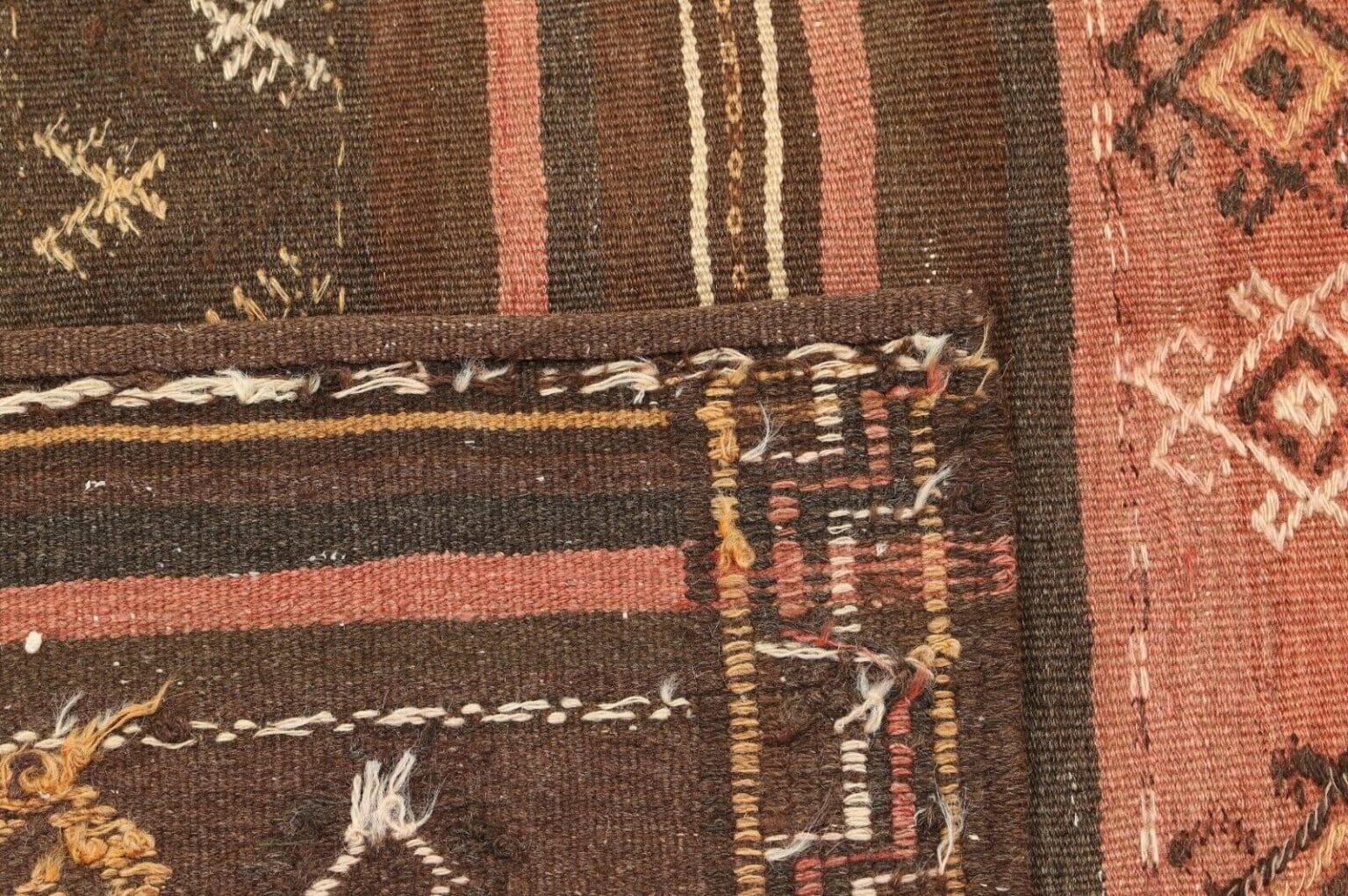
Flat weaving also explains why Kilims are technically different from knotted rugs. A knotted rug develops its design through rows of individual knots that create a pile. A Kilim instead forms a compact plane of interlaced threads. The two methods belong to the wider history of Oriental rug making, but they should not be confused when describing a particular piece. This rug is specifically identified as hand-woven and as a Kilim.
Origin and Tradition
The country of manufacture for this rug is unknown. It is therefore presented as an Oriental rug without assigning it to a named province or country. The term Oriental rug describes the textile category and its wider cultural context; it is not proof of a particular place of production. No origin in Iran, Turkey, India or another weaving region is given for this piece, so no more specific provenance is stated.
Kilim weaving is one of the long-established flat-weaving traditions associated with the Orient. Woven textiles were made in nomadic, village and urban settings and could serve several purposes, including floor coverings, wall textiles, blankets or household furnishings. A flat textile could be folded, carried and used in different ways. These practical requirements contributed to the development of many constructions, layouts and decorative systems across the wider tradition.
The work begins with the arrangement of the warp on a loom. The warp threads establish the lengthwise framework. Weft yarn is then inserted across them and beaten into place. When one colour area ends, another can be introduced to continue the design. The maker must control the tension of the warp, the density of the weft and the alignment of the pattern. In a hand-woven piece, these actions are performed through a craft process rather than being reduced to a fully standardised machine sequence.
Different weaving communities developed their own approaches to flat-weave construction. Some Kilims use narrow repeated diamonds, others broad bands, stepped outlines or larger central fields. Colour choices may range from restrained combinations to pronounced contrasts. These differences can be characteristic of particular traditions, but they do not by themselves establish the origin of an individual rug. Since the manufacturing country of this rug is unknown, its regional provenance remains open.
The history of the Kilim is closely connected to the way textiles functioned in everyday life. A woven piece could be useful as well as decorative, and it could become part of a household over an extended period. The technique joins the practical need for a durable textile with the wish to give the surface an ordered design. This rug is assigned to the late twentieth century, specifically the period from 1970 to 1999. That period describes its stated historical classification and does not identify a particular workshop or country.
Oriental weaving traditions include many different rug forms, and flat-woven Kilims represent one important branch among them. Their appearance can vary according to yarn, loom, structure, colour arrangement and local practice. A hand-woven piece does not need to imitate one single regional formula. Its identity can instead be described through the construction that is present: wool, a woven flat surface and a geometric design. For this rug, those technical and visual facts are more precise than an unverified regional label.
The continued use of hand weaving also preserves a method in which the maker responds directly to the developing textile. The spacing of the warp and the placement of the weft influence the eventual proportions of the design. Small differences may occur as the work advances. These are normal consequences of a manual process and help explain why hand-woven rugs are individual objects. They should not be treated as evidence of a specific country when no country has been recorded.
Design and Pattern
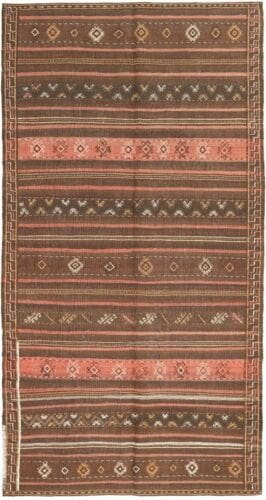
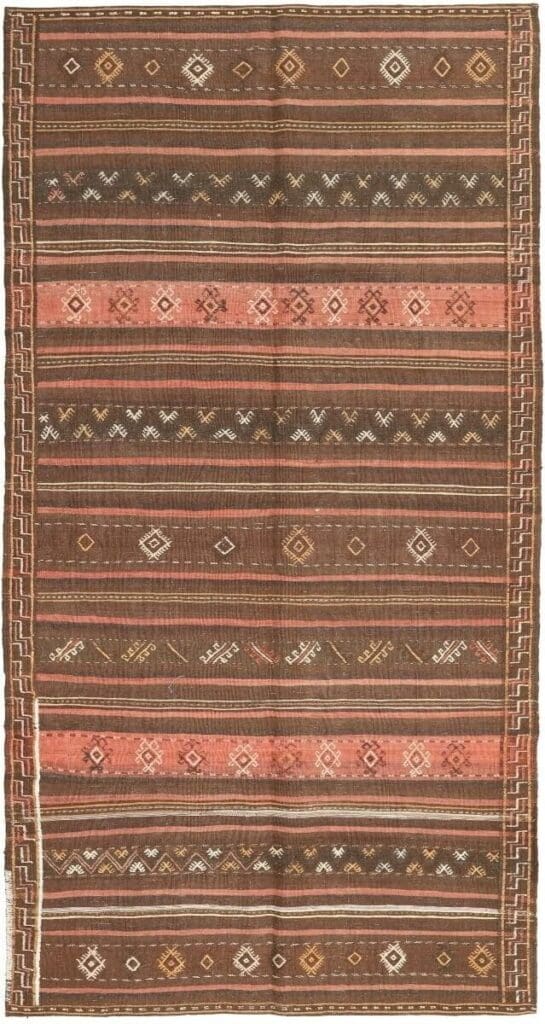
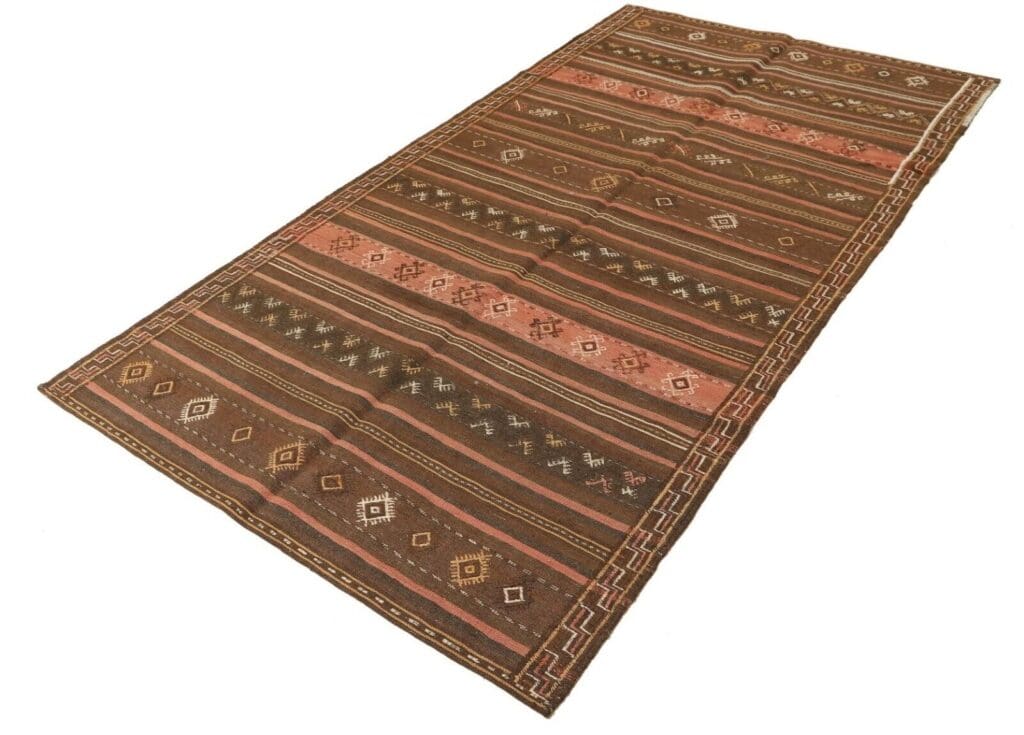
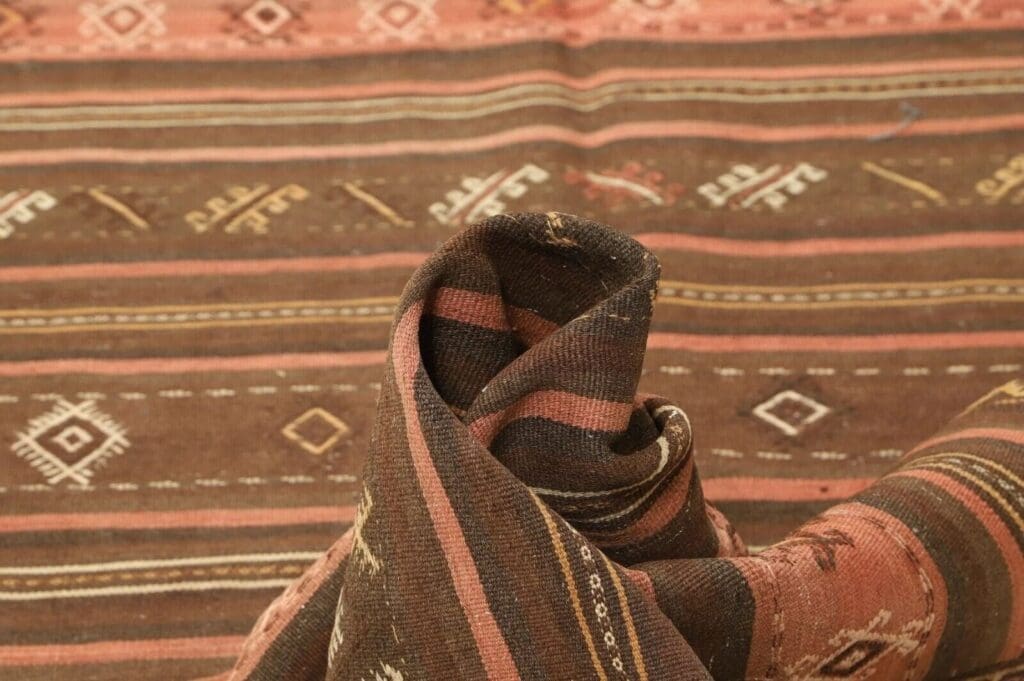
The pattern of this rug is described as geometric. Geometric Kilim designs are formed from recognisable lines, angles, diamonds, stepped shapes, triangles and repeated fields. Instead of relying on softly modelled botanical drawing, they organise the surface through edges, intervals and colour changes. A design may appear highly symmetrical, or it may contain small shifts created during hand weaving. In both cases, the visual effect comes from rhythm, proportion and the relationship between adjoining areas.
Geometric forms have been among the most enduring devices in the history of flat-woven textiles. Diamonds can be repeated in a continuous arrangement, while zigzags and stepped lines create movement across the surface. Hooks, notches and interlocking angles may strengthen the boundary between fields. The meaning of a particular sign, however, depends on the tradition in which it is used and cannot be established from geometry alone. For this rug, the reliable pattern description is simply geometric.
Unlike a design embroidered or printed onto a completed cloth, a Kilim pattern is created during weaving. The weaver follows the intended layout by placing coloured weft yarn through the warp in separate sections. Each new section changes the colour and shape of the developing field. Beating the weft closes the structure and fixes the design into the textile. This process gives many Kilims a direct, graphic quality and makes their decoration inseparable from their construction.
A geometric layout can organise a rug in several ways. A central field may concentrate the design, a repeated motif may establish a regular rhythm, and stripes may guide the eye across the surface. Smaller angular elements can connect larger areas or form a border-like transition. These are general possibilities within geometric Kilim design, not claims about an unrecorded motif on this particular rug. The source identifies the pattern category but does not name individual symbols, colours or a specific layout.
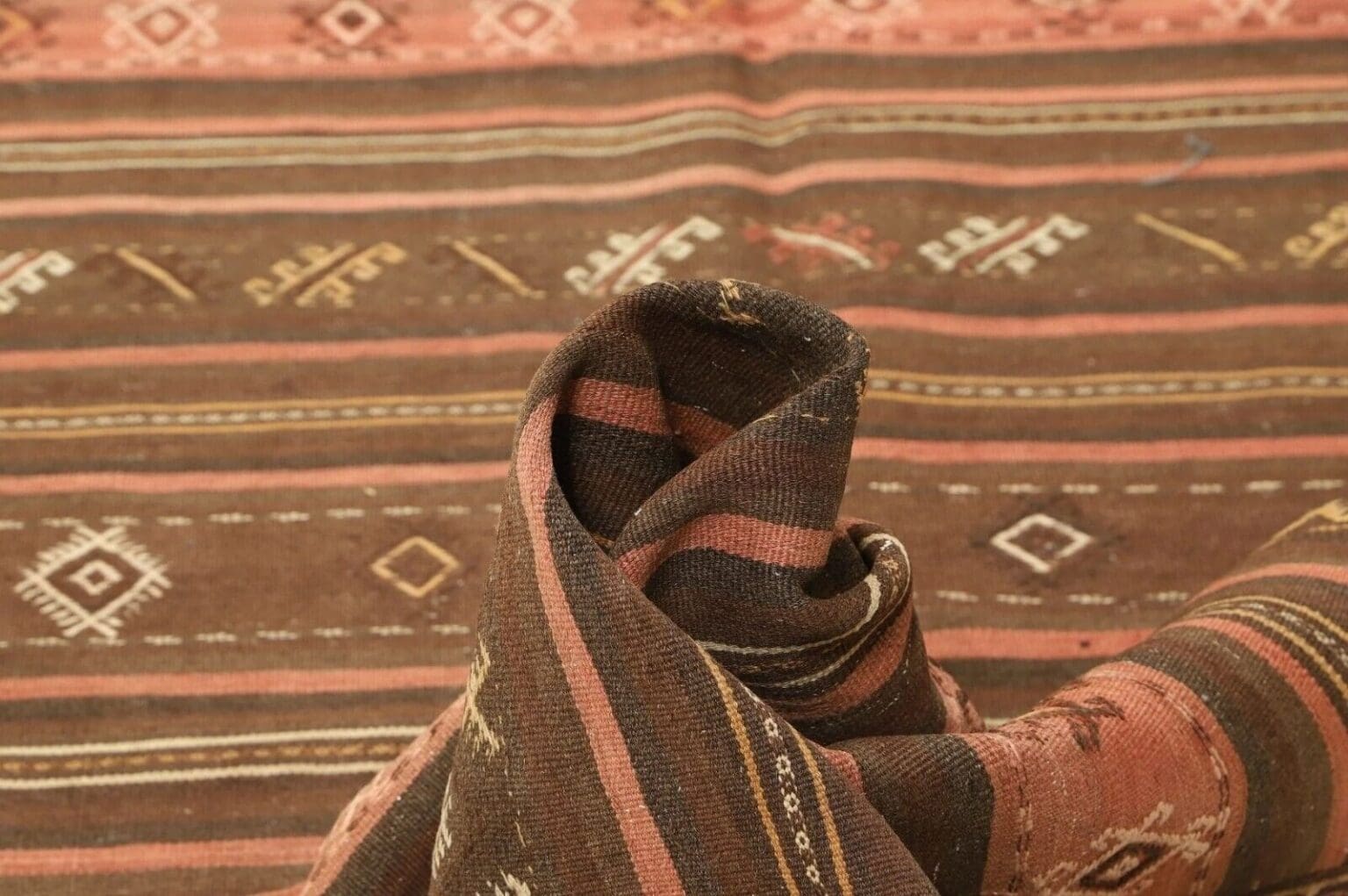
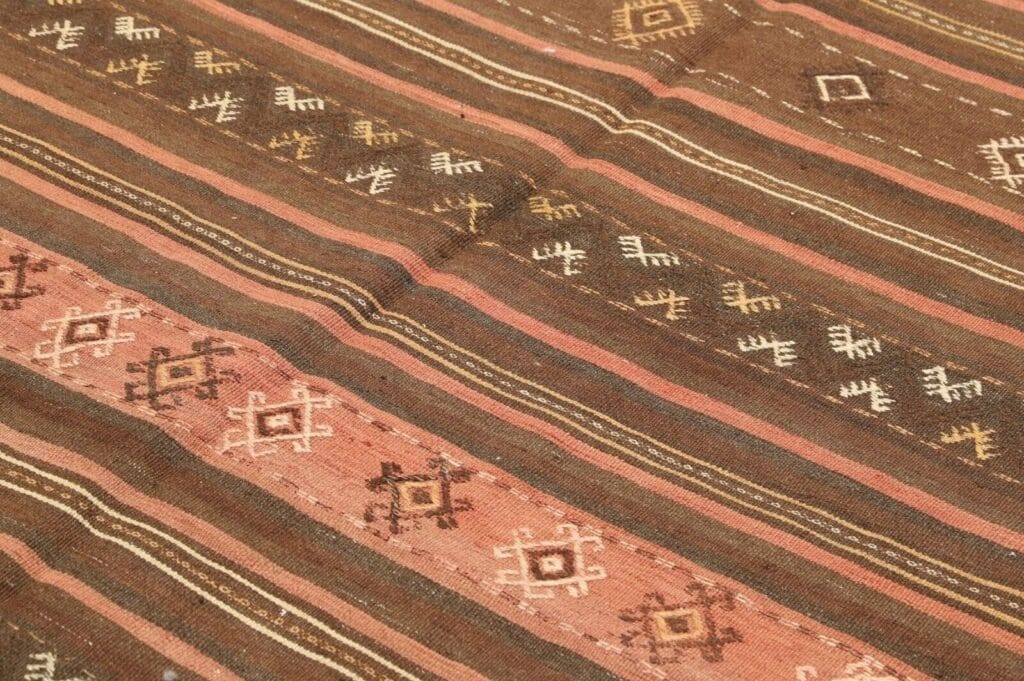
The flat surface affects the way the design is seen. Light interacts with woven threads differently from the surface of a cut pile. Depending on the viewing angle, the weft, the colour fields and the transitions between them may become more or less prominent. The pattern remains connected to the structure of the fabric rather than floating above it. In hand weaving, slight variations in line width or thread tension can occur as part of the manual production process.
Geometric Kilims can work with both restrained and more varied interiors because their design is based on clear visual units. A repeated arrangement may bring order to a room, while a stronger contrast can make the textile function as a graphic surface. This describes the general role of the pattern type and does not prescribe a particular placement for this rug. The individual piece is characterised by its wool construction, hand-woven Kilim technique and geometric pattern.
The design language of a flat weave is also shaped by the limits and possibilities of the loom. Straight edges, stepped diagonals and repeated angular units can be built efficiently with weft sections. Curves are often translated into stair-step forms or segmented outlines. This relationship between geometry and technique is one reason geometric motifs appear so often in Kilim traditions. The visual vocabulary is not separate from the craft; it grows directly out of the way the textile is made.
Special Features
The rug is described as used and as being in top quality. It is also listed as abrasion-resistant, non-slip and dirt-repellent, and it is identified as eco-friendly. These statements describe the condition and special features recorded for the piece. Its hand-woven wool Kilim construction is another distinguishing characteristic. The manufacturing country is unknown, and no province or workshop is specified.
The rug is assigned to the late twentieth century, from 1970 to 1999. This time period is part of its stated classification. The flat woven construction sets it apart from a hand-knotted rug, while the wool material and geometric pattern provide the remaining specific description. No further regional attribution or detailed motif name is given.
FAQ
What is a Kilim?
A Kilim is a flat-woven rug. Its pattern is formed by inserting and compacting coloured weft yarn through the warp, rather than by tying individual knots that create a cut pile. This produces a relatively flat textile surface with a graphic appearance. The rug offered here is described as a hand-woven wool Kilim.
Where was this Oriental rug made?
The country of manufacture is unknown. For that reason, the rug cannot be assigned to a named province or national weaving tradition. Oriental rug is used here as a category describing the type of textile and its broader cultural context, not as evidence of a documented country of origin. A more specific attribution would not be supported by the product information.
How is the condition of the rug described?
The rug is listed as used and as being in top quality. The description also identifies it as abrasion-resistant, non-slip and dirt-repellent, and calls it eco-friendly. These statements summarise the recorded condition and special features. The rug is additionally described as a hand-woven wool Kilim from the late twentieth century.
To provide the best experiences, we use technologies like cookies to store and/or access device information. Consenting to these technologies will allow us to process data such as browsing behavior or unique IDs on this site. Not consenting or withdrawing consent, may adversely affect certain features and functions.
Functional Always active
The technical storage or access is strictly necessary for the legitimate purpose of enabling the use of a specific service explicitly requested by the subscriber or user, or for the sole purpose of carrying out the transmission of a communication over an electronic communications network.
Preferences
The technical storage or access is necessary for the legitimate purpose of storing preferences that are not requested by the subscriber or user.
Statistics
The technical storage or access that is used exclusively for statistical purposes.The technical storage or access that is used exclusively for anonymous statistical purposes. Without a subpoena, voluntary compliance on the part of your Internet Service Provider, or additional records from a third party, information stored or retrieved for this purpose alone cannot usually be used to identify you.
Marketing
The technical storage or access is required to create user profiles to send advertising, or to track the user on a website or across several websites for similar marketing purposes.

 SECURE PAYMENT
 SHIPPING PARTNERS


