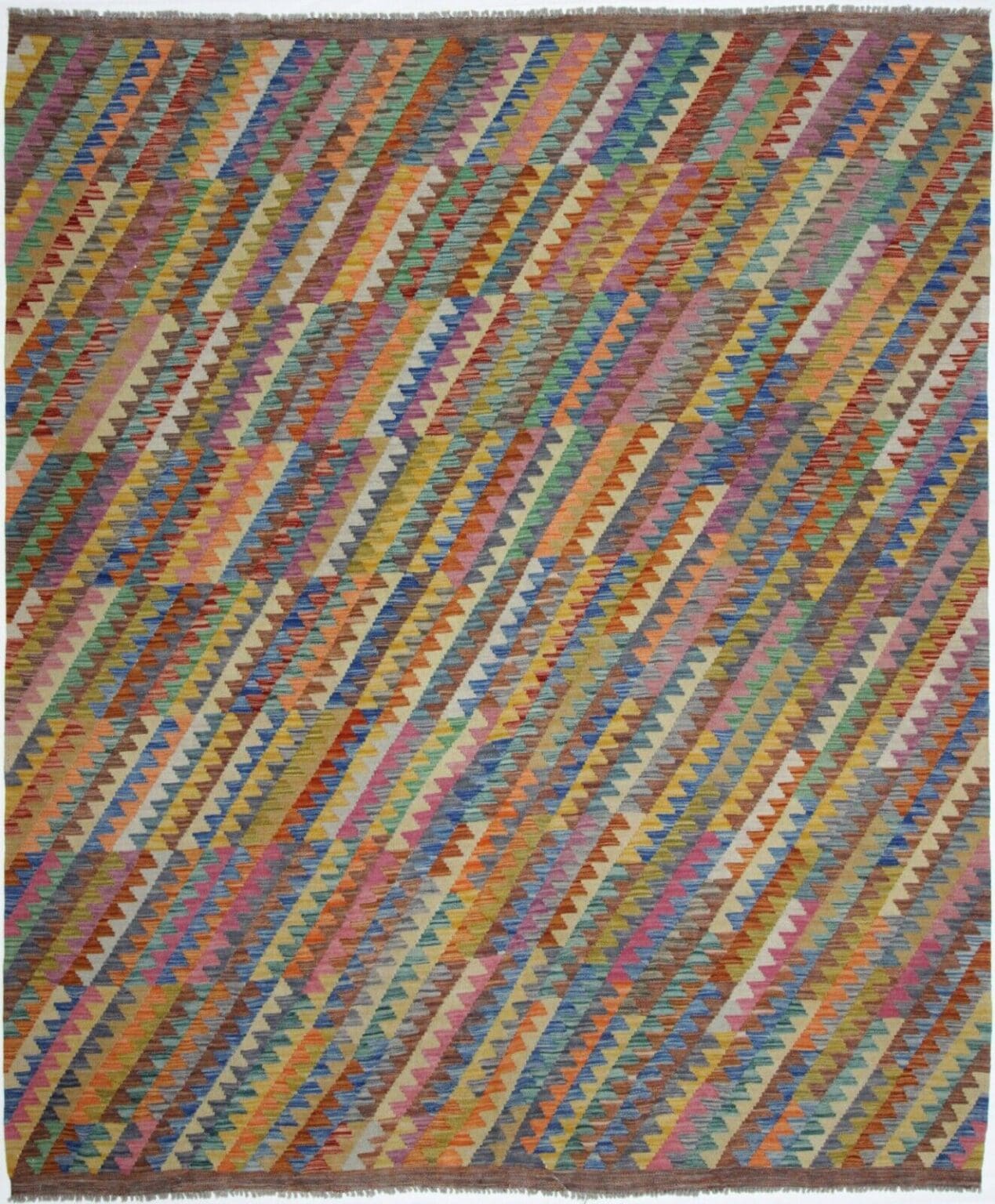
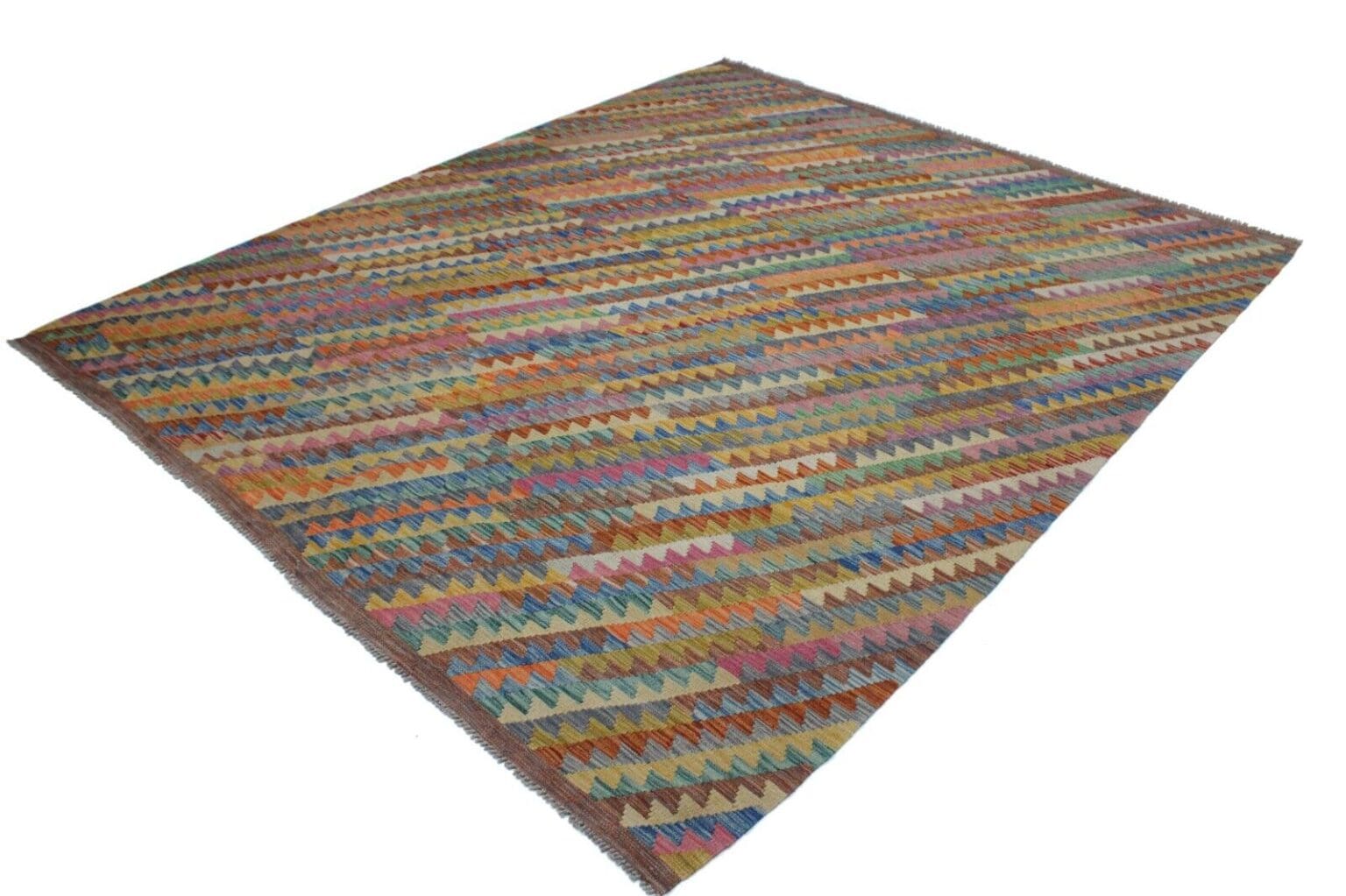
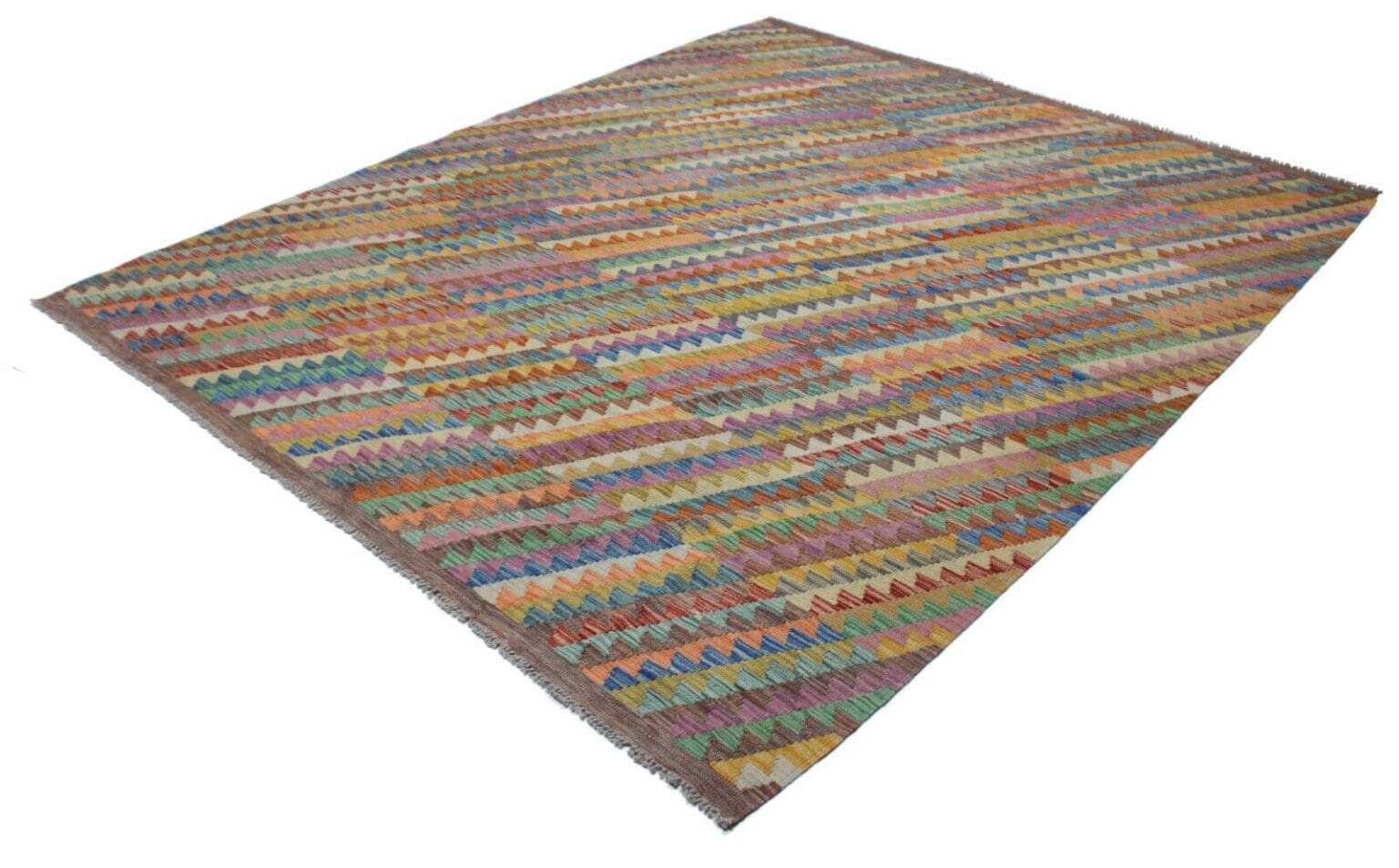
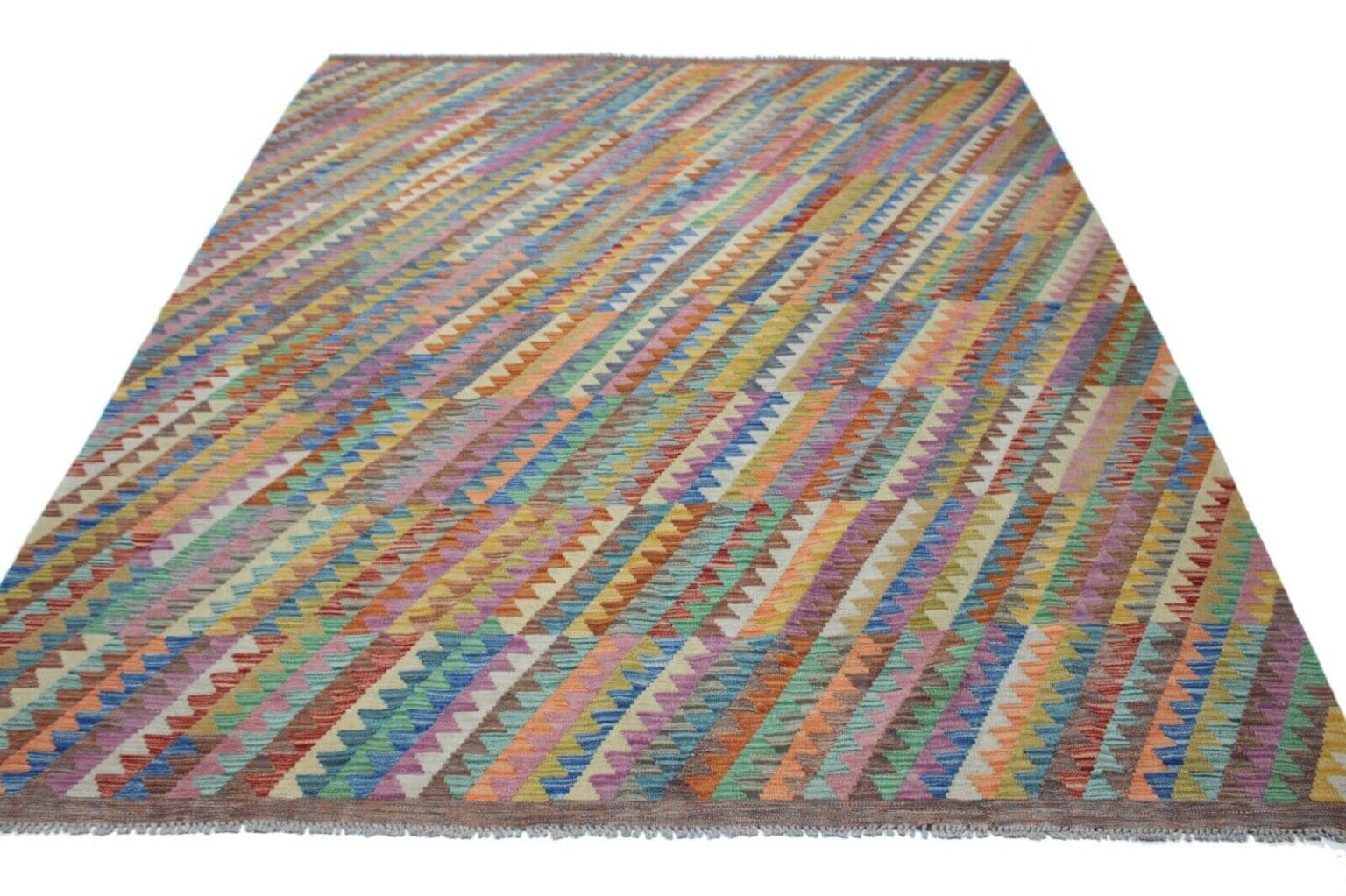
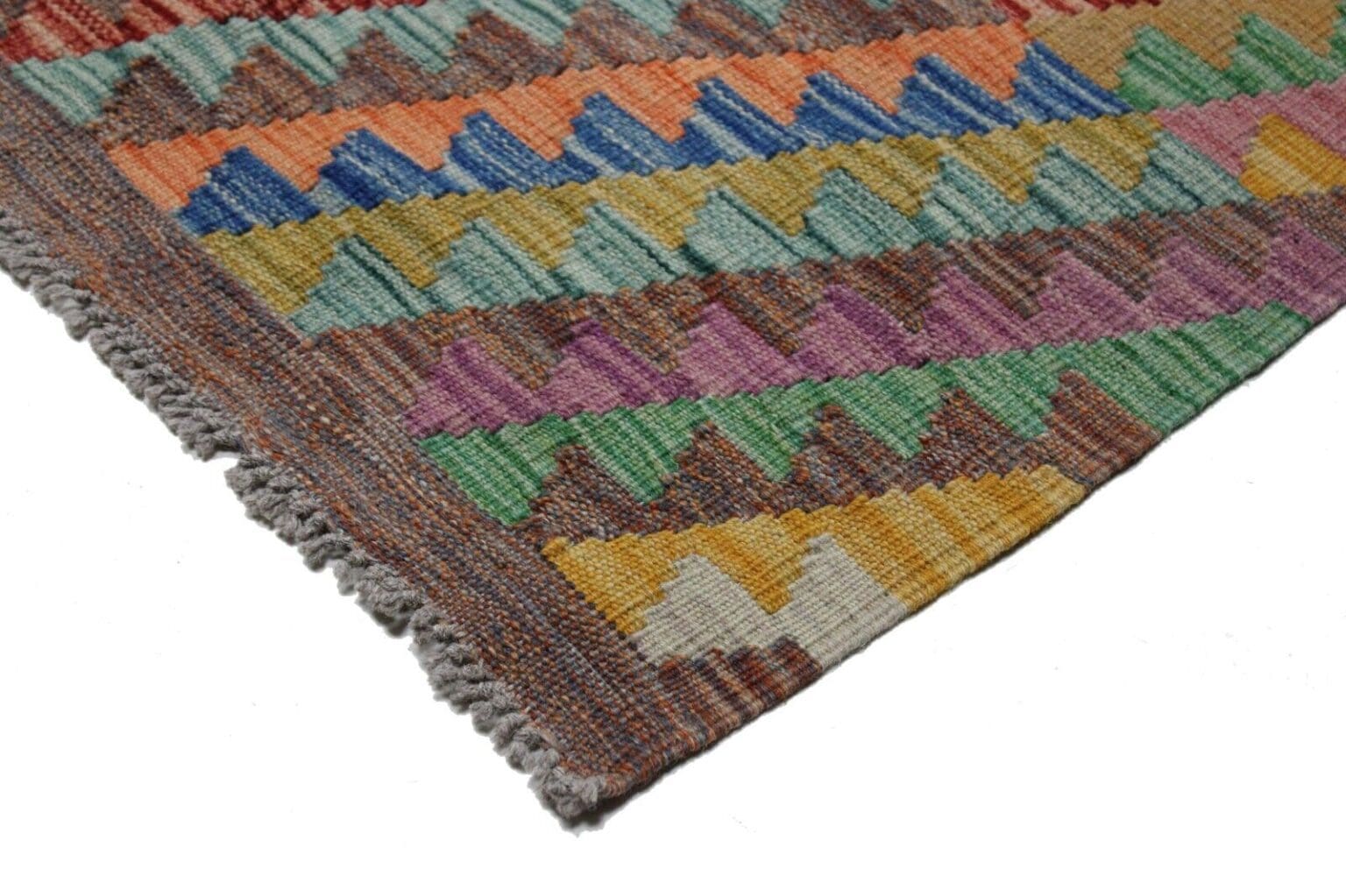
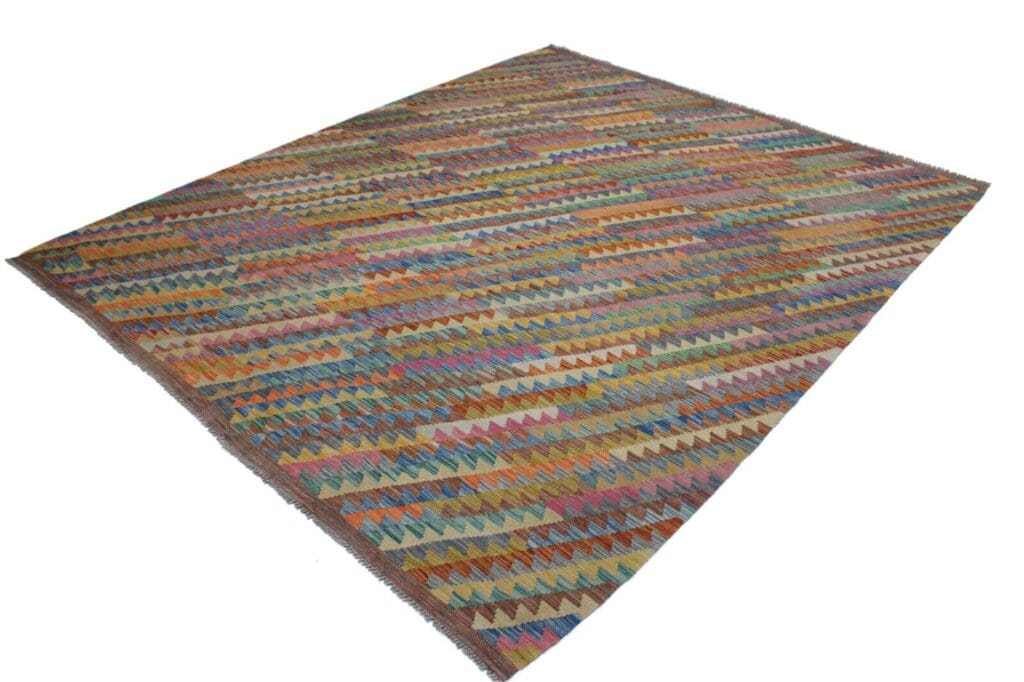
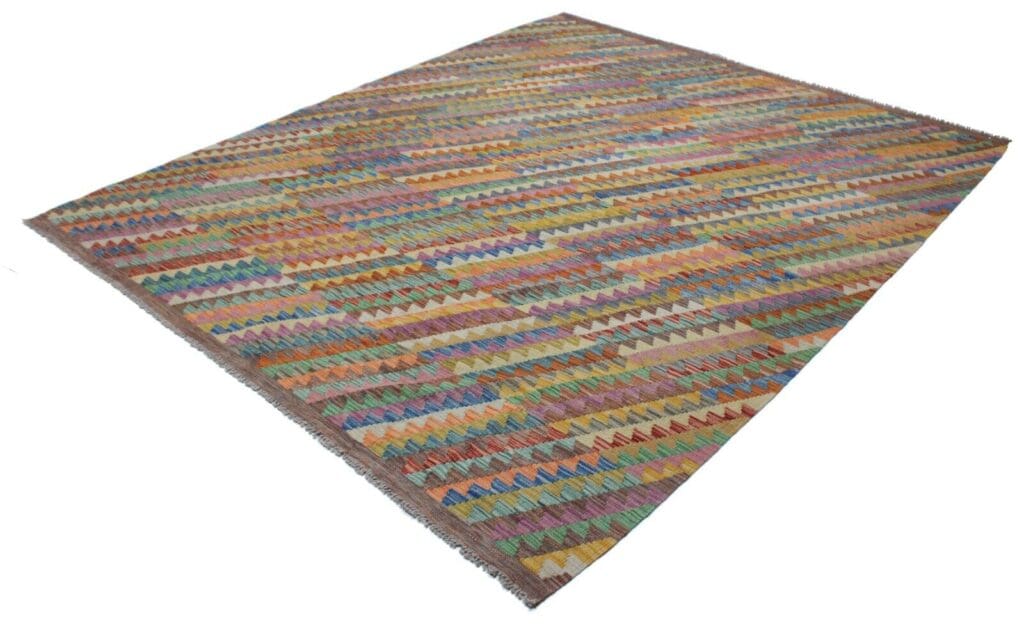
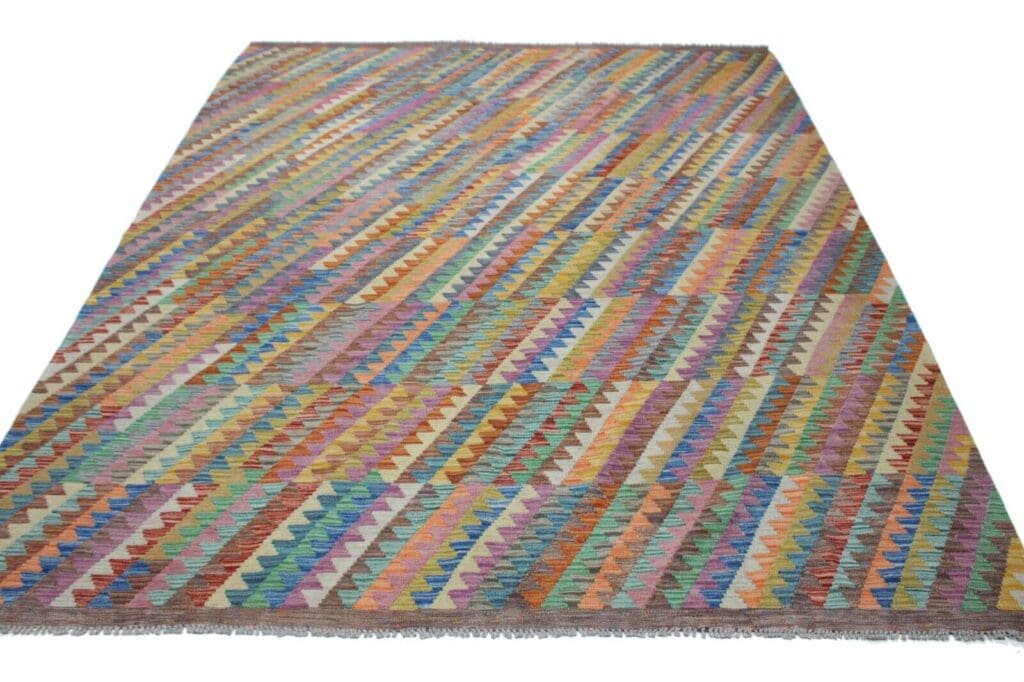
This Oriental rug is described as a hand-woven Old Styl Kilim. A Kilim is made by interlacing warp and weft to form a textile surface, rather than by creating a raised, cut pile through knotting. The method belongs to the long history of flat-woven rugs and gives the piece its level profile and visible structure. The rug is specifically described as usable on both sides, so the woven construction remains part of its practical character.
Wool is listed as the material for the pile or textile surface. Wool has long been used in hand-made rugs because its natural fibres can be spun, dyed and woven into a resilient fabric. It also accepts colour well, allowing geometric areas and outlines to remain distinct. The feel of wool depends on the yarn and the weaving process, while its presence gives the textile a substantial, tactile quality without requiring a high pile.
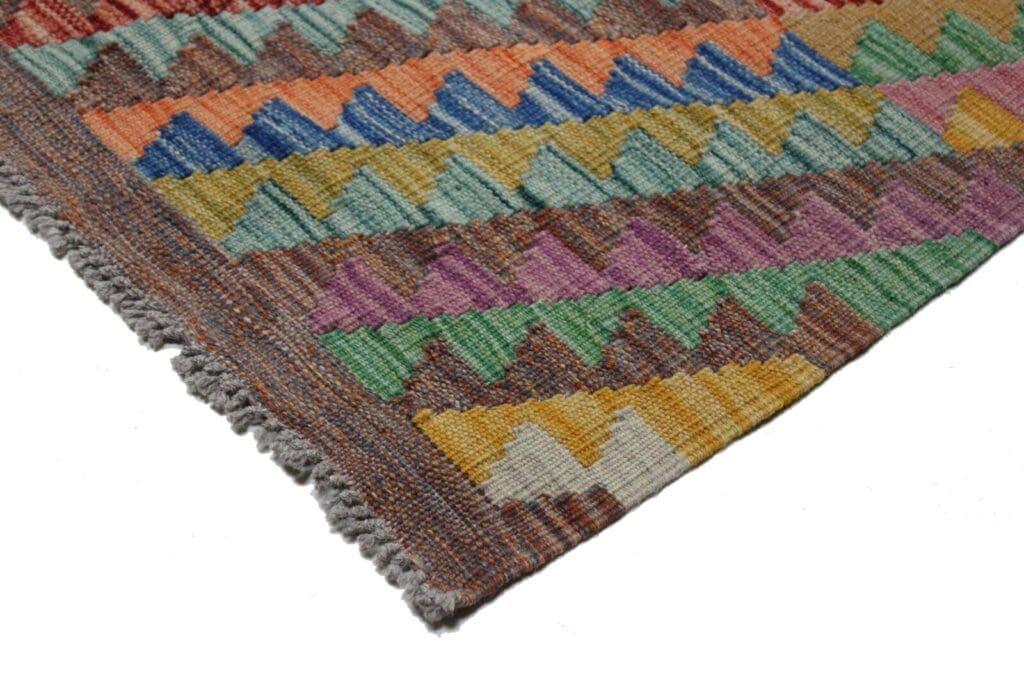
The short pile and stated thickness reinforce the flat character of this Kilim. In a flat weave, the design is built into the textile rather than sitting above it as a separate layer of knotted pile. This makes the structure easy to see and gives the pattern a direct, graphic appearance. The source identifies the rug as hand-woven and as a Kilim; no additional claim about machine production or industrial reproduction is made.
The rug is new and comes with a tag. It is also described as suitable for use over underfloor heating. That information concerns its intended use and should be combined with the flooring manufacturer’s instructions and appropriate installation practice. Depending on the floor and the room, a suitable non-slip underlay can help keep a flat-woven rug stable and protect the textile from unnecessary movement.
Origin and Tradition
The rug is presented as an Oriental rug with Afghan regional design. Here, Afghan refers to the stated design association rather than adding an unprovided claim about a particular place of manufacture. Afghan-influenced rugs and Kilims belong to a broad textile tradition in which flat construction, strong outlines and repeated symbols are common features. The term Old Styl indicates a visual approach based on older and established design languages, not a stated age for this individual rug.
Afghanistan has a diverse history of textile production shaped by nomadic groups, village communities and specialised workshops. Flat-woven pieces could serve as floor coverings, household textiles or portable furnishings. Their construction made them practical in different settings, while local access to wool and dyes influenced the appearance of each weaving tradition. As a result, Afghan design is not one single pattern system. It includes varied arrangements, colour relationships, borders and geometric vocabularies.
The wider history of Oriental flat weaving is closely connected with the useful nature of the craft. A Kilim does not depend on a tall pile to create a durable textile surface. Instead, the weaver controls the relationship between warp and weft and builds the image through selected weft colours. In separate colour areas, the weft may be carried only as far as needed before another area begins. This construction can produce small shifts and irregularities, which are part of the visual evidence of hand work.
Wool has an important place in many rug traditions across western and central Asia. It can be prepared as yarn, coloured with dyes and worked into a fabric suited to everyday use. In flat weaving, the result depends on more than the fibre alone. Spinning, yarn preparation, tension, the order of the colours and the finishing of the edges all affect the finished textile. These stages explain why a flat-woven rug can have considerable visual and structural character even when its surface is deliberately low.
Rugs are often discussed through names linked to regions, communities, workshops or characteristic designs. Those categories should not automatically be treated as interchangeable. In this case, the source gives Afghan as the regional design and does not name a specific province or city of origin. Calling the piece an Oriental rug therefore keeps the description within the supplied facts, while the Afghan design reference identifies the tradition informing its visual language.
Design and Pattern
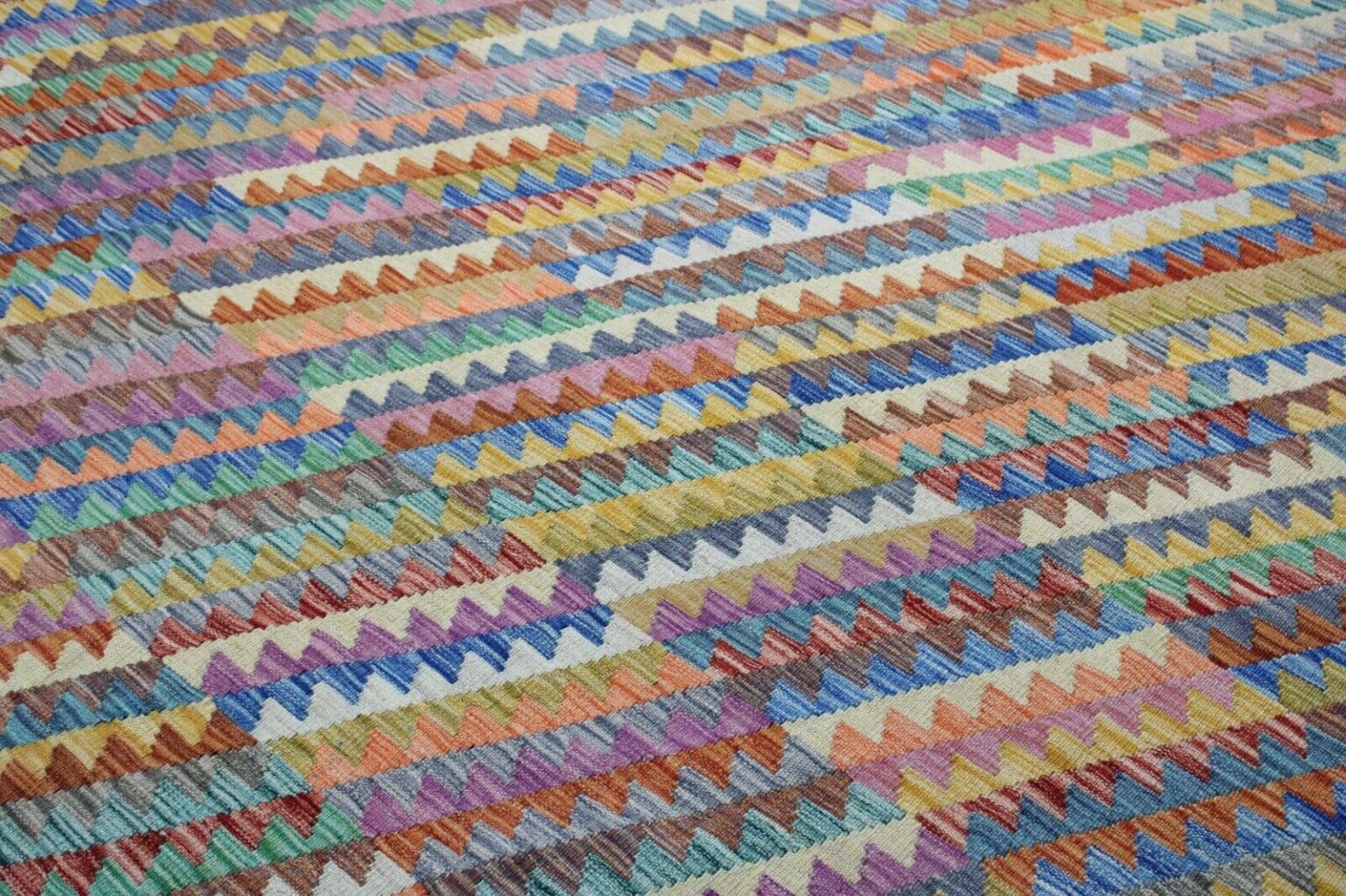
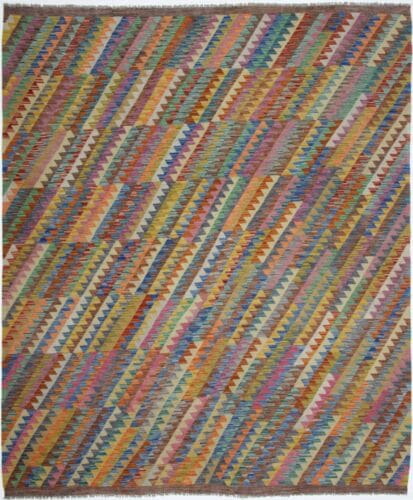
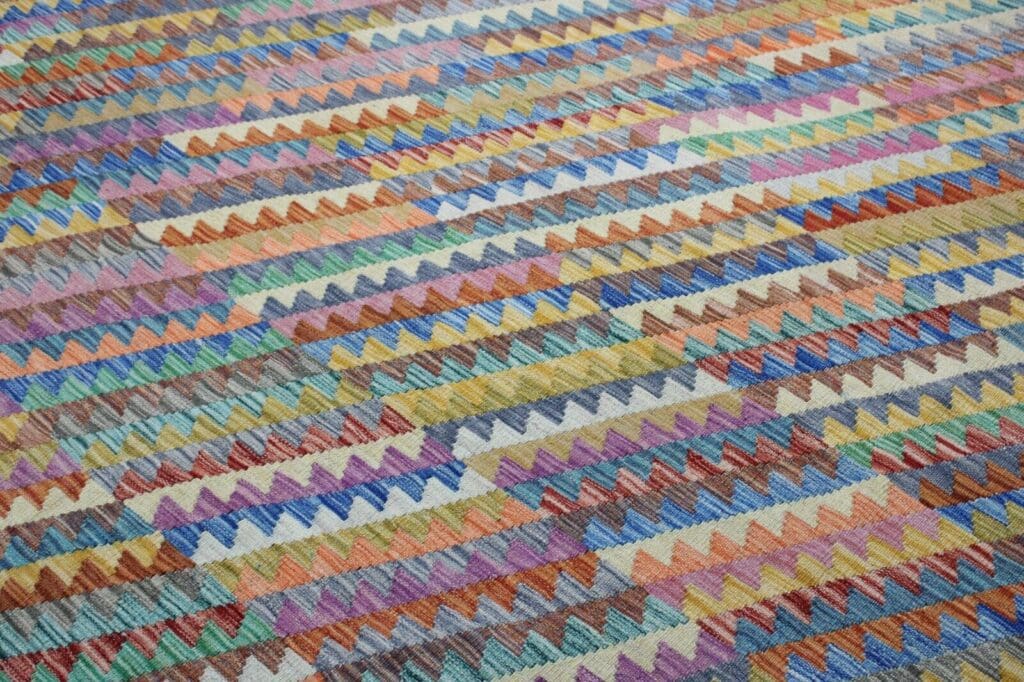
The pattern is geometric. Geometric rug designs use lines, angles, stepped contours, diamonds, stripes and repeated fields to organise the surface. They do not rely on a naturalistic depiction of flowers, animals or landscapes. On a Kilim, these shapes are not merely printed onto a finished fabric. They are formed through the placement and interlocking of coloured weft sections, so the image and the construction remain closely connected.
An Old Styl Kilim can draw on earlier design vocabularies while making no claim about the age of the individual piece. The phrase describes a stylistic direction. Traditional flat-woven compositions may use a central arrangement, a sequence of repeated motifs or a balance of bordered fields. Repetition provides a clear rhythm, while small differences in contour, spacing or colour transition preserve the character of a hand-made textile.
Afghan-associated geometric designs are often discussed in relation to signs developed from simple shapes. Diamonds may function as recurring medallions, symbols or devices for dividing a field. Zigzags can create movement, and stepped lines can define the edges of a motif. Such interpretations belong to the general vocabulary of textile design and should not be treated as a specific symbolic reading of this rug. What is established here is its geometric pattern and the Afghan regional design designation.
The flat weave affects how the pattern is seen. A low surface creates less pile shadow than a deep, tufted rug, so the outlines depend primarily on colour changes and the structure of the weave. The graphic quality can be read from either side because the piece is reversible, although light and orientation may affect how the two surfaces are perceived. Reversibility does not create a second design; it reflects the way the woven textile has been constructed.
Geometric Kilims can sit alongside a range of furnishing styles because their visual order is based on proportion and repetition rather than on a single naturalistic subject. They may define an area, connect separate colours in a room or provide a patterned textile element without a raised surface. These are general qualities of geometric flat weaves, not promises about a particular interior. For this rug, the documented features are the geometric pattern, the Afghan regional design, the Old Styl Kilim form and the ability to use both sides.
Special Features
The reversible construction is one of the rug’s stated features. With a flat-woven Kilim, both sides can be used when they are placed on a clean, dry and suitable surface. This makes the textile practical while also showing how its pattern is integrated into the weave. As with any rug, the floor should be free of sharp projections, and a non-slip base may be useful where movement is possible.
The rug is described as new with a tag. It is suitable for use over underfloor heating, has a short pile and the stated low thickness associated with its construction. Wool is listed as the material, while the pattern is geometric and the regional design is Afghan. No knot density, signature, age, named manufacturing city or other provenance detail is supplied for this piece, so those details are not added here.
FAQ
How should I care for a hand-woven wool Kilim?
Vacuum regularly and gently to remove loose dust and debris. On a flat weave, use a suitable setting and avoid aggressive brush action that could catch an edge or stress the woven structure. If liquid is spilled, absorb it promptly with a clean, absorbent cloth instead of rubbing the area. For a deeper clean, a professional service experienced with wool rugs and Kilims is the appropriate choice. Prolonged direct sunlight can gradually affect colours, so balanced placement and occasional repositioning can help limit uneven exposure. Always allow the textile and the floor beneath it to remain dry.
What distinguishes a hand-woven Kilim?
A Kilim does not have the upright, cut pile associated with a conventional knotted rug. Its pattern is created while warp and weft are being woven together, which gives the surface a flat profile and makes the construction visible. The same structure can allow both sides to be used. Hand-woven textiles may show individual variations in tension, outlines and colour transitions, reflecting the making process. This rug combines the listed wool material, geometric pattern, Afghan regional design and Old Styl Kilim form. It is described as new and supplied with a tag.
How can I assess the quality of a Kilim?
For a Kilim, useful points of inspection include the consistency of the weave, the strength and straightness of the edges, the joining of colour areas and the finish at the ends. The quality and feel of the wool also influence how the textile performs over time. The design should be formed clearly by the weave, without loose sections or visible damage. Knot density is not the appropriate single measure for a flat-woven Kilim because its construction is not based on rows of knotted pile. For this piece, the stated features are hand-woven Kilim construction, wool, a short pile, new condition and reversible use.
To provide the best experiences, we use technologies like cookies to store and/or access device information. Consenting to these technologies will allow us to process data such as browsing behavior or unique IDs on this site. Not consenting or withdrawing consent, may adversely affect certain features and functions.
Functional Always active
The technical storage or access is strictly necessary for the legitimate purpose of enabling the use of a specific service explicitly requested by the subscriber or user, or for the sole purpose of carrying out the transmission of a communication over an electronic communications network.
Preferences
The technical storage or access is necessary for the legitimate purpose of storing preferences that are not requested by the subscriber or user.
Statistics
The technical storage or access that is used exclusively for statistical purposes.The technical storage or access that is used exclusively for anonymous statistical purposes. Without a subpoena, voluntary compliance on the part of your Internet Service Provider, or additional records from a third party, information stored or retrieved for this purpose alone cannot usually be used to identify you.
Marketing
The technical storage or access is required to create user profiles to send advertising, or to track the user on a website or across several websites for similar marketing purposes.

 SECURE PAYMENT
 SHIPPING PARTNERS


