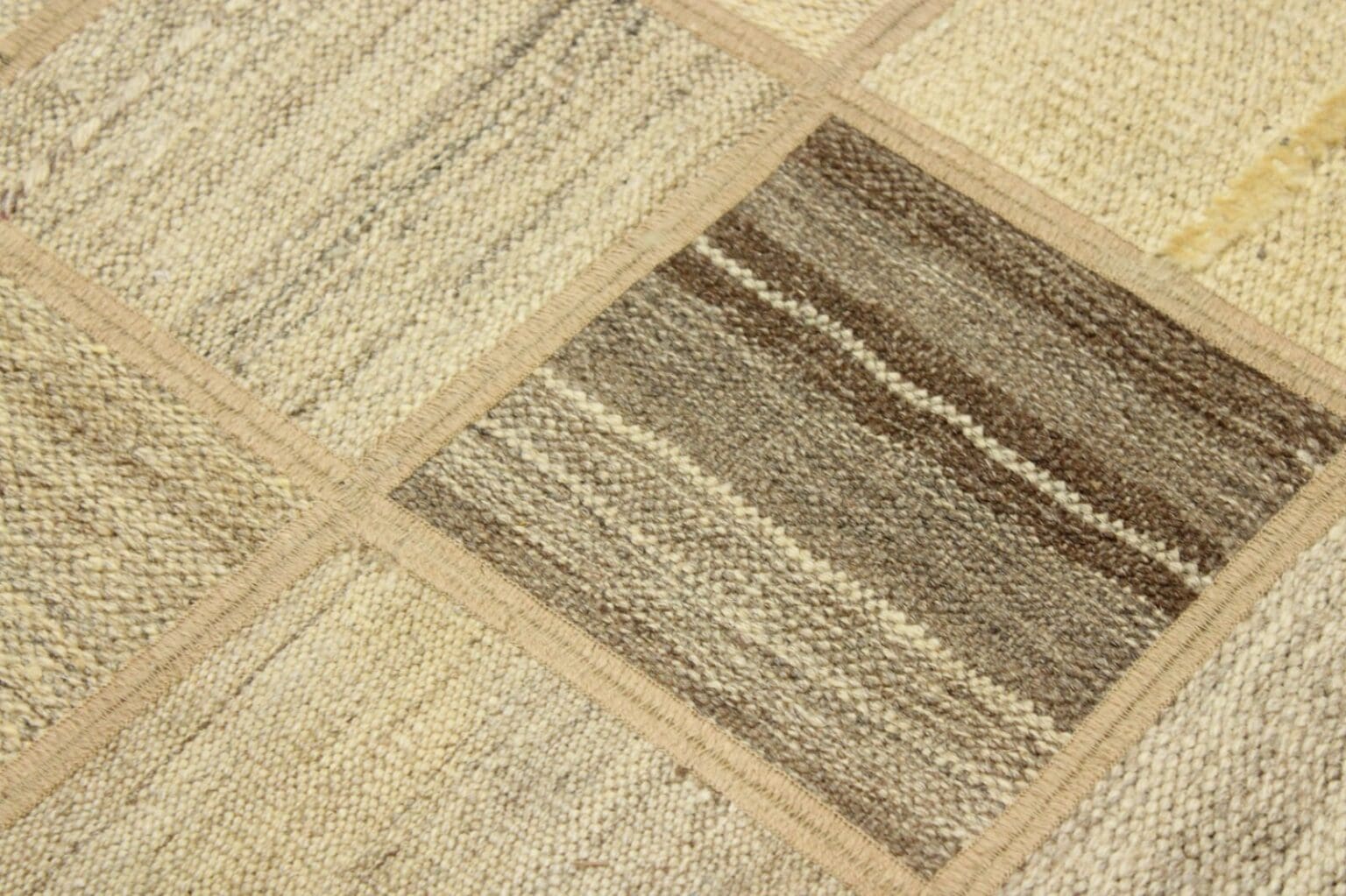
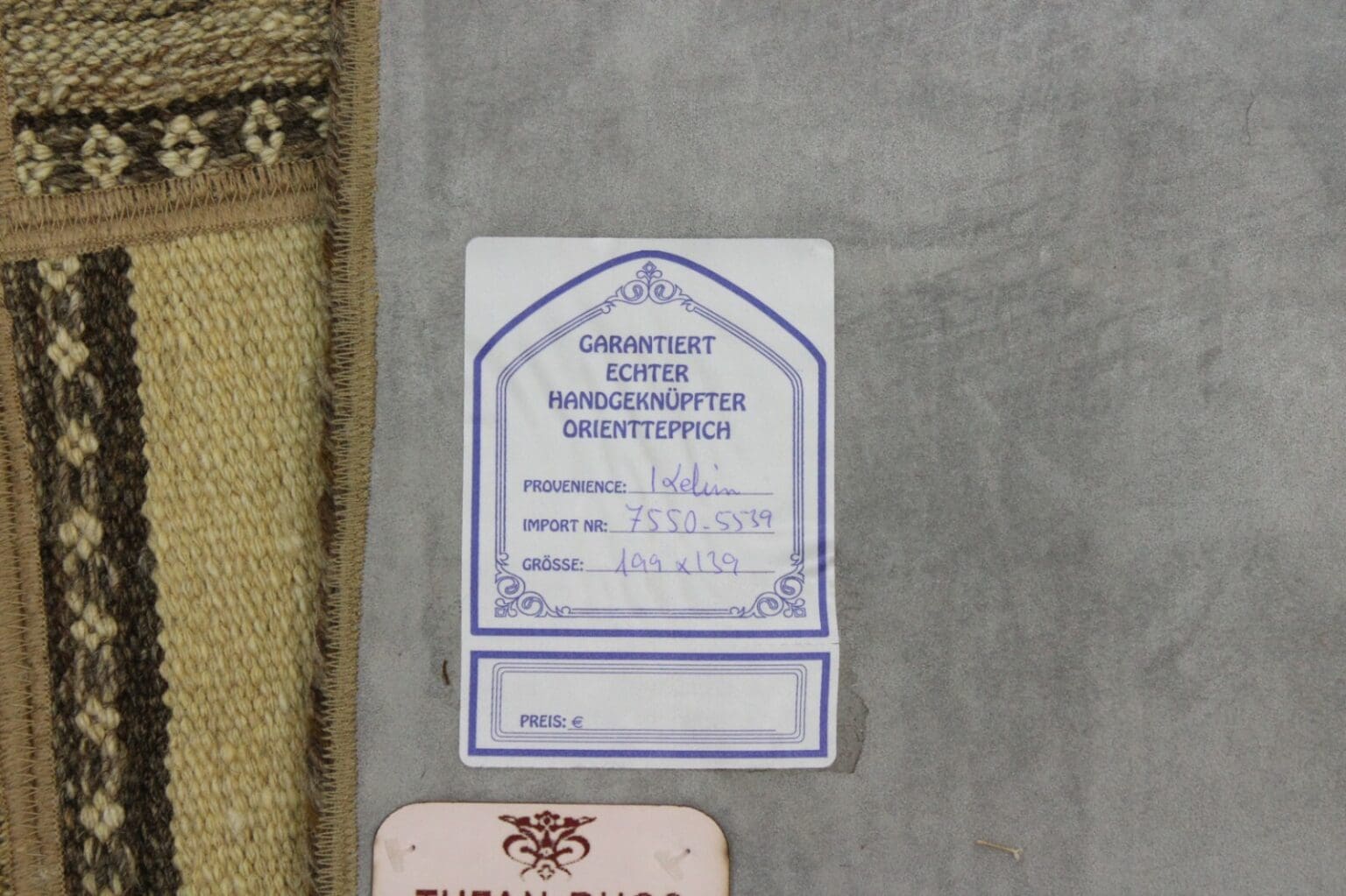
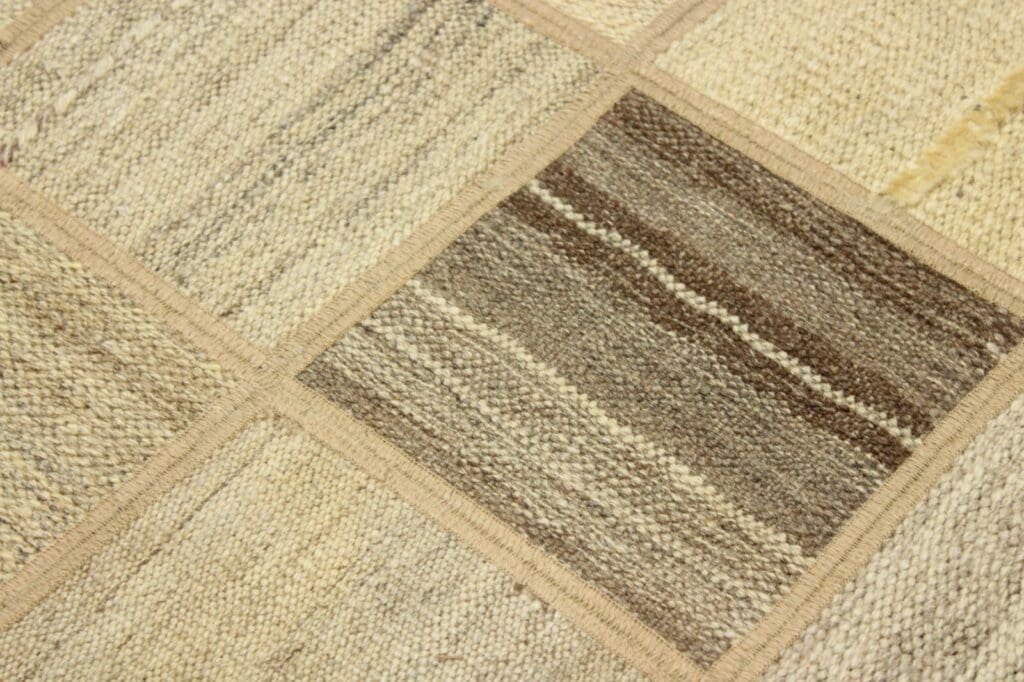
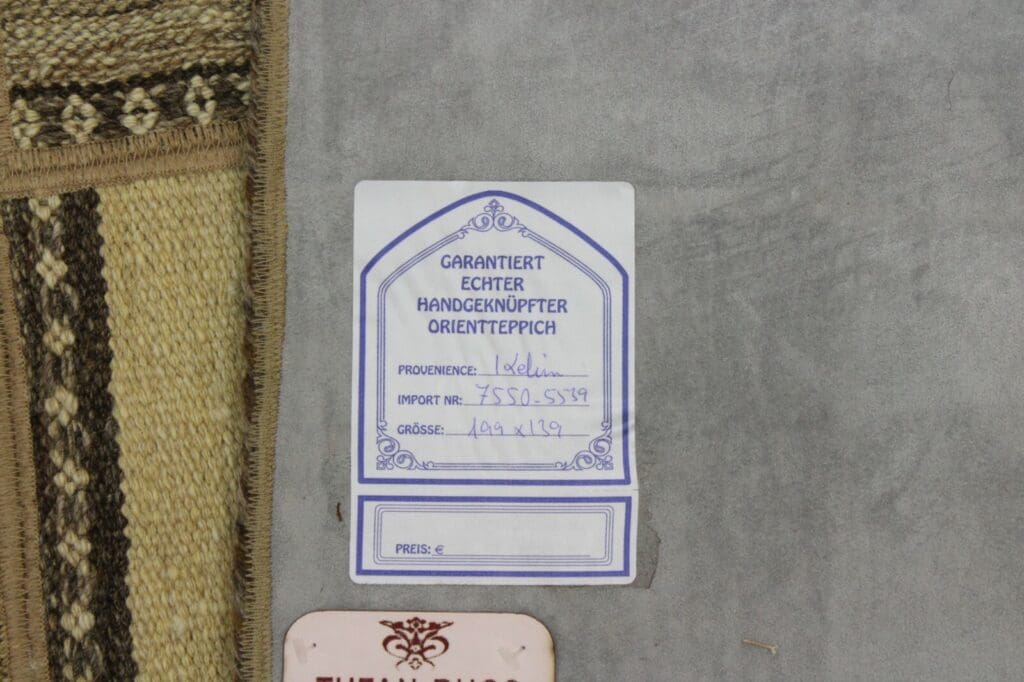
This rug is hand-woven and made as a Kelim. Hand-woven construction means that the textile is formed manually on a loom rather than produced by a machine. In a Kelim, the weft threads create the visible surface, while the structure is built through the controlled interlacing of warp and weft. Unlike a pile rug, a flat-woven Kelim does not depend on rows of individually knotted tufts to create a raised surface. The result is a textile in which the weave itself is central to both appearance and construction.
Kelim weaving belongs to a long-established group of flat-weaving techniques found across the Oriental rug world. The weaver works across the width of the loom, passing the weft through the warp and compressing each line to form a stable surface. Changes in colour or pattern can require careful handling of separate areas of weft. Small openings, stepped contours and visible transitions may occur where woven sections meet; these are characteristics associated with the way geometric flat-woven designs are constructed.
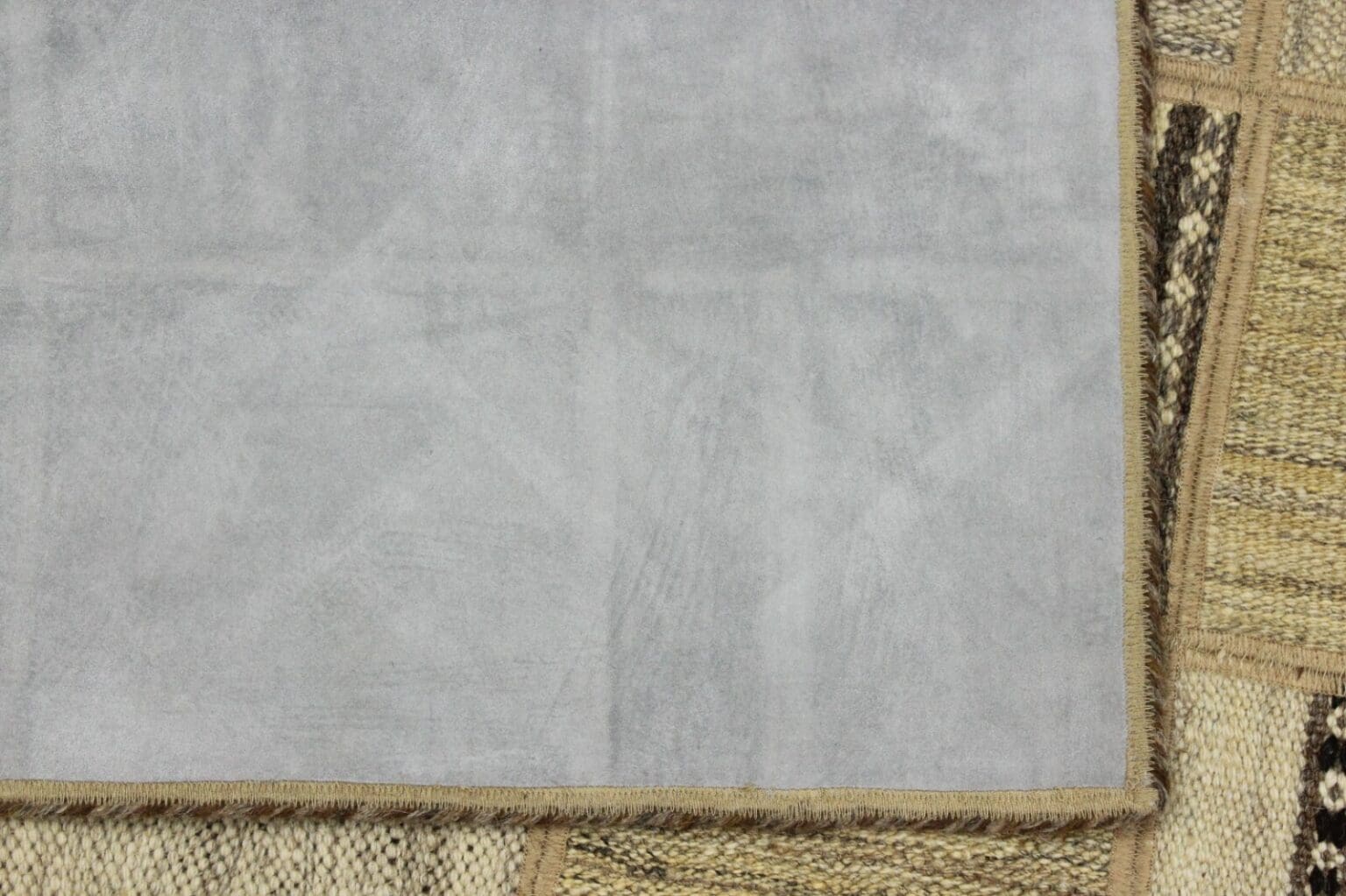
The source identifies this piece as a hand-woven Kelim but does not specify its fibre composition. No statement is therefore made here about wool, cotton, silk or another material. The same restraint applies to the foundation and to any finishing details. What defines the documented construction is the manual weaving technique and the Kelim format. These terms describe how the textile was made without adding material claims that are not established for this individual piece.
Origin and Tradition
Kelim weaving has developed in several regions where portable looms, repeated motifs and practical flat textiles formed part of everyday textile culture. It is associated with weaving traditions from the Near East, Central Asia, Anatolia, the Caucasus and neighbouring areas. The technique is not limited to one town or one country. Similar structural principles can appear in different local traditions, while the vocabulary of motifs, the organisation of colour and the handling of the edges may vary from one weaving centre to another.
Flat-woven textiles have historically served more than one purpose. They could be used as floor coverings, tent furnishings, storage textiles, dividers or decorative fabrics. Their relatively compact construction made them suitable for movement and everyday use in communities with a mobile or semi-mobile way of life. The loom, the available fibres, the intended use and the experience of the weaver all influenced the resulting textile. These conditions helped produce a broad range of regional Kelim traditions rather than a single uniform style.
Persian rug traditions are an important part of the wider history of Oriental textiles, with weaving centres such as Kerman, Tabriz, Isfahan and Shiraz known for their own approaches to pattern and colour. Those names refer to regional traditions and should not be read as an origin statement for every rug with a related motif. A Kelim may belong to a different local tradition, and a pattern reference alone does not establish where a particular textile was made. This product is described as an Oriental rug and as a hand-woven Kelim; no province or country of manufacture is assigned to it in the product information.
The modern use of the Kelim format extends this history into contemporary interiors. Designers and weavers may retain the logic of flat weaving while arranging traditional-looking forms in new compositions. Patchwork construction is part of this modern vocabulary because it allows separate textile sections to be assembled into one overall design. The result can connect the visual language of older woven textiles with a more current approach to layout, proportion and surface structure.
Design and Pattern
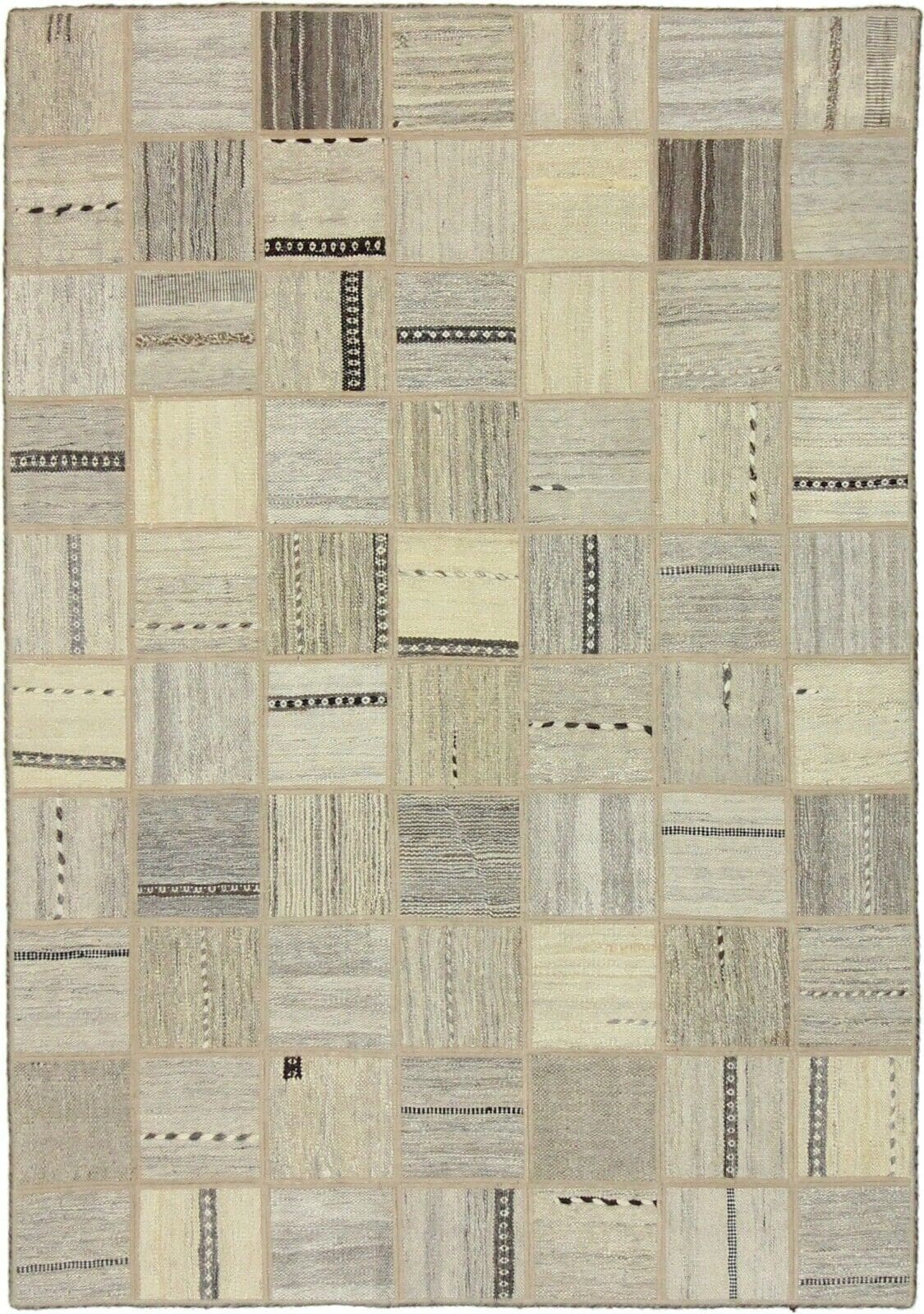
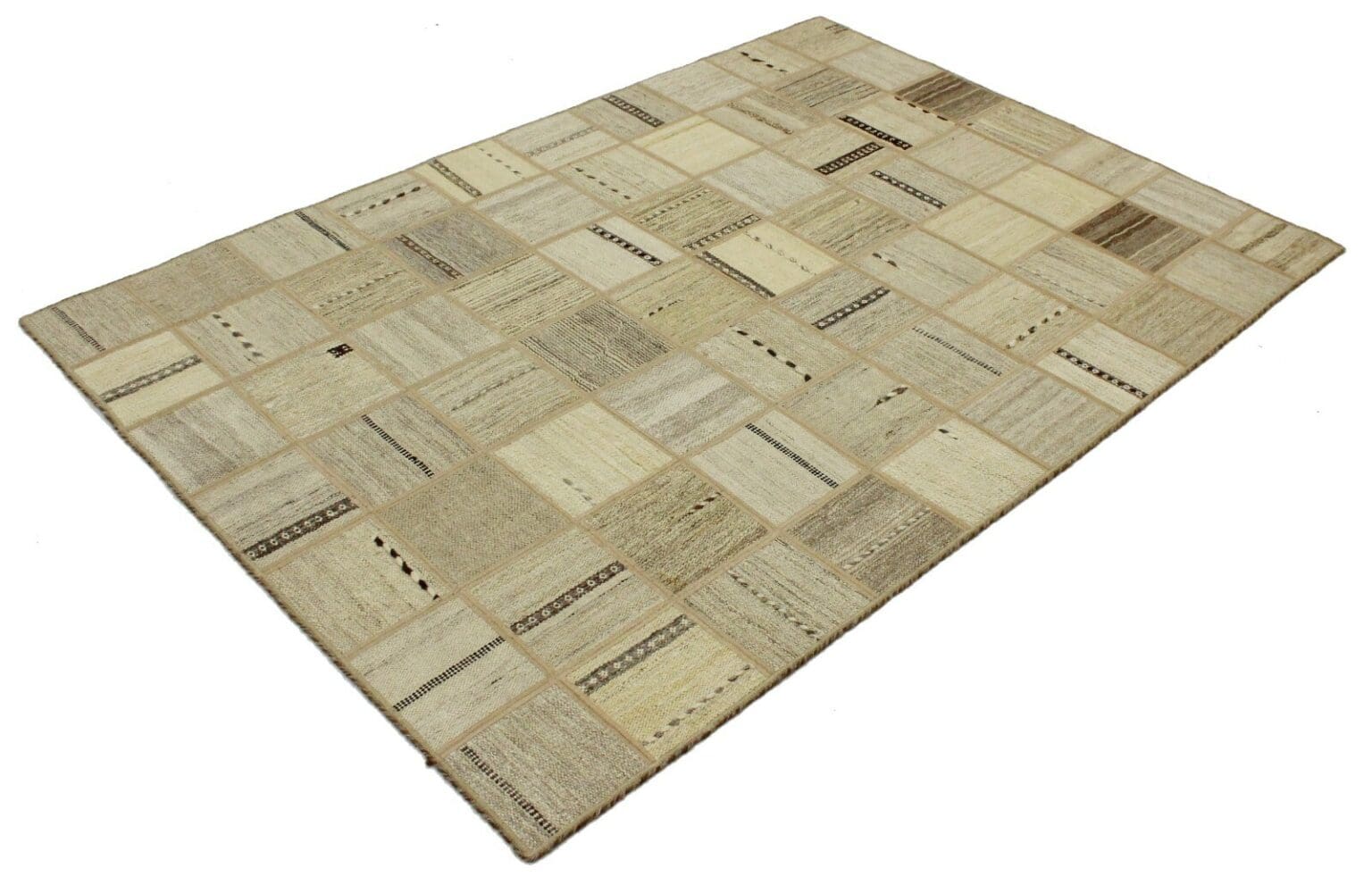
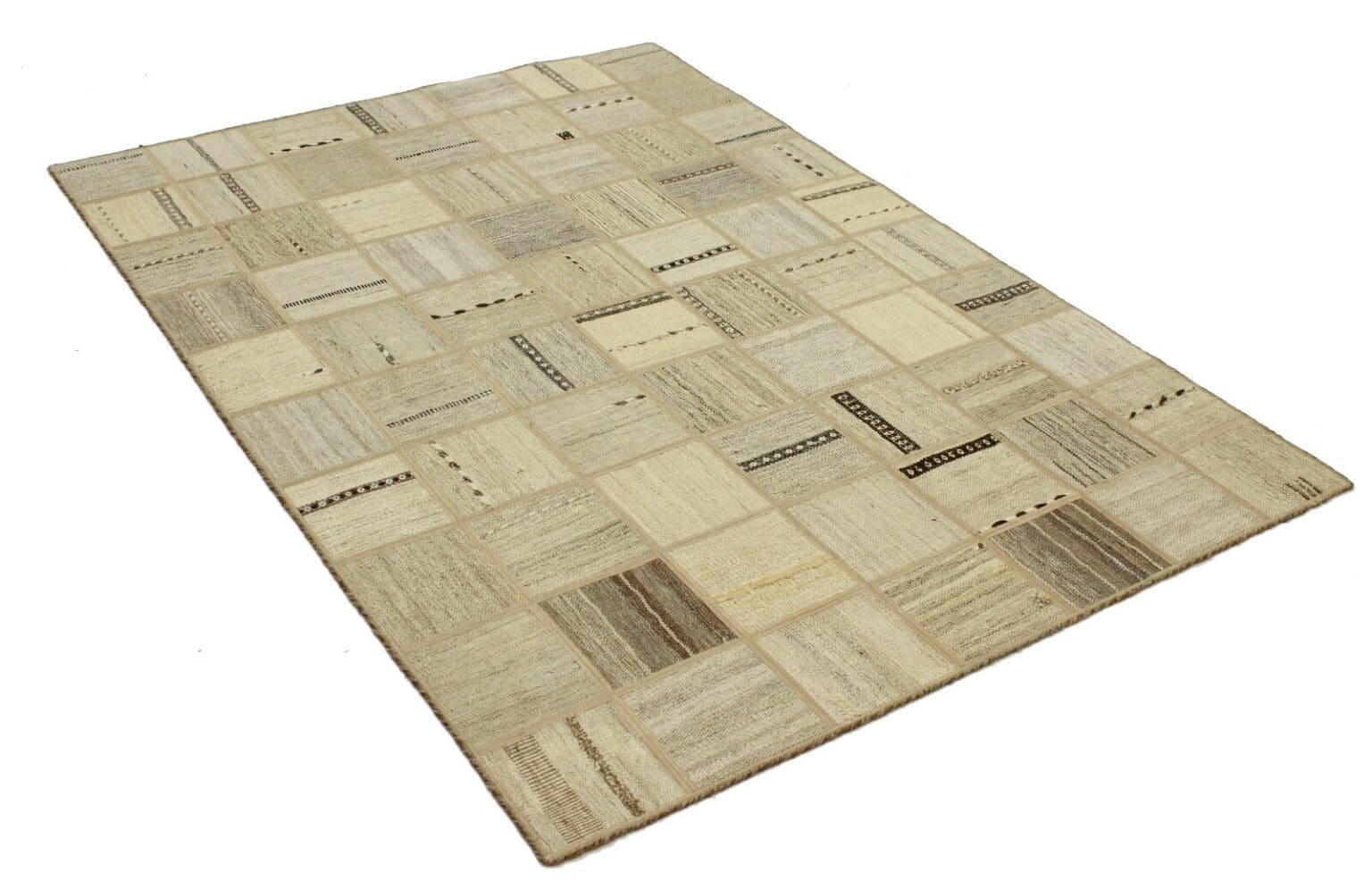
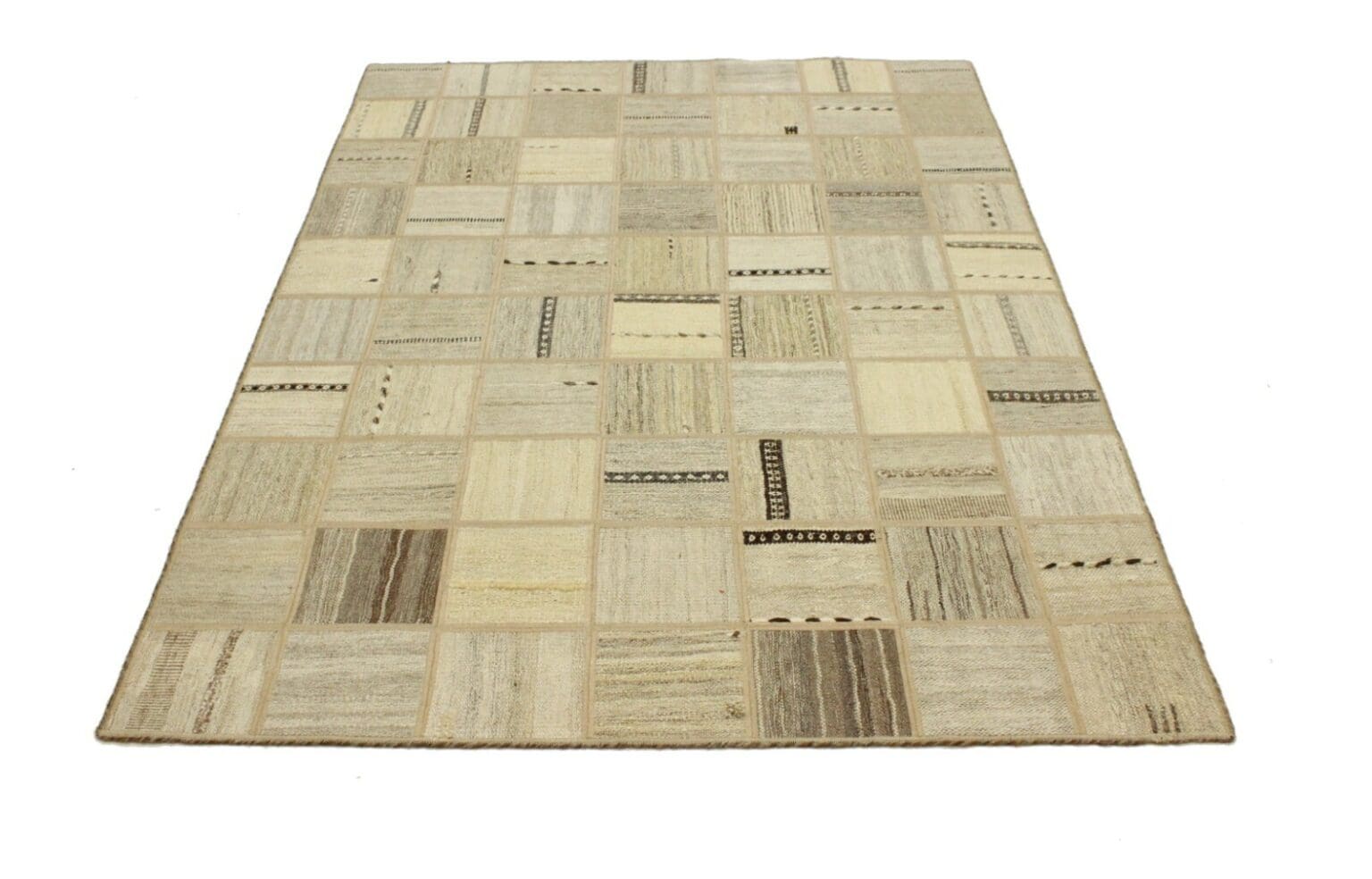
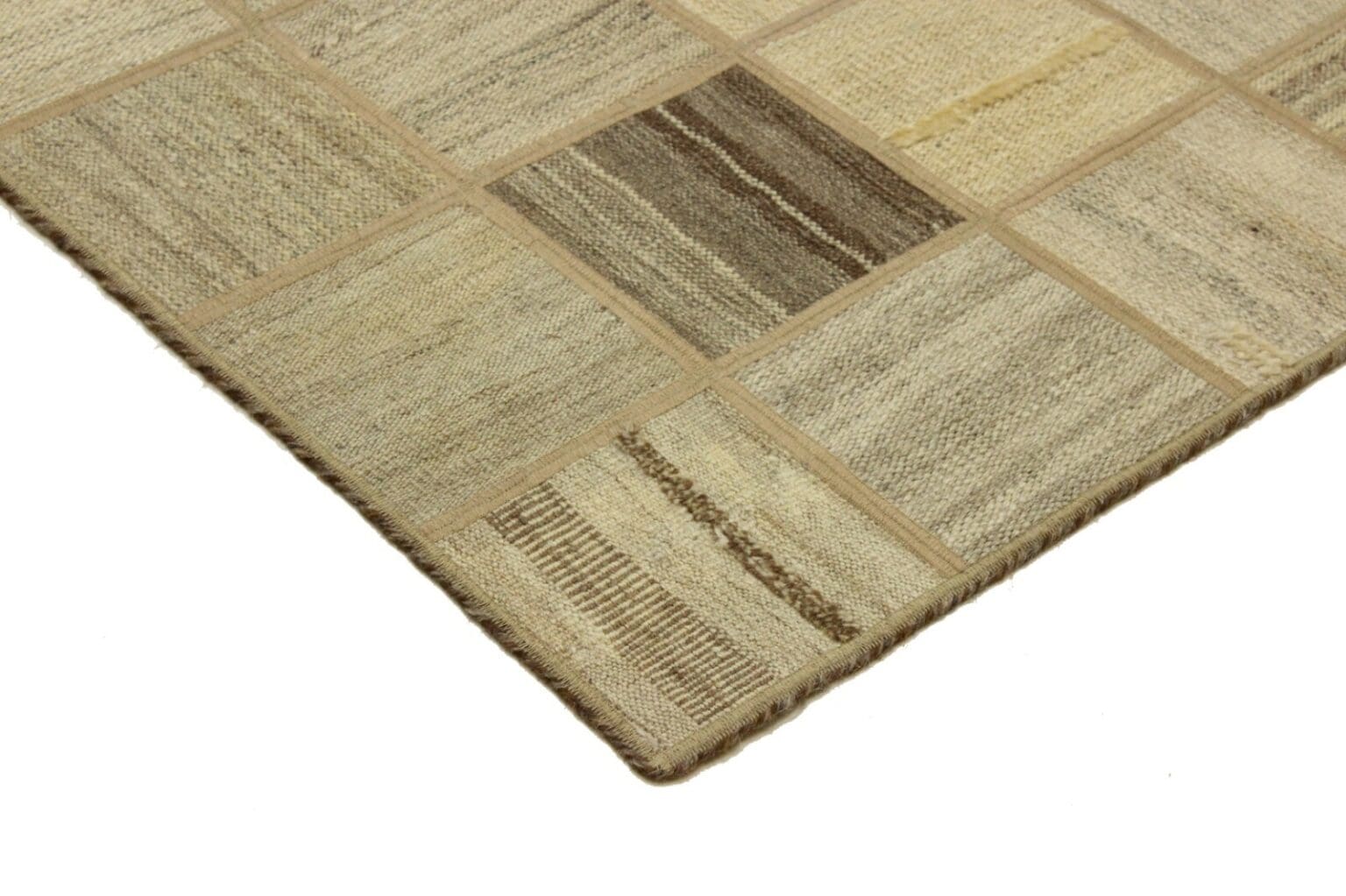
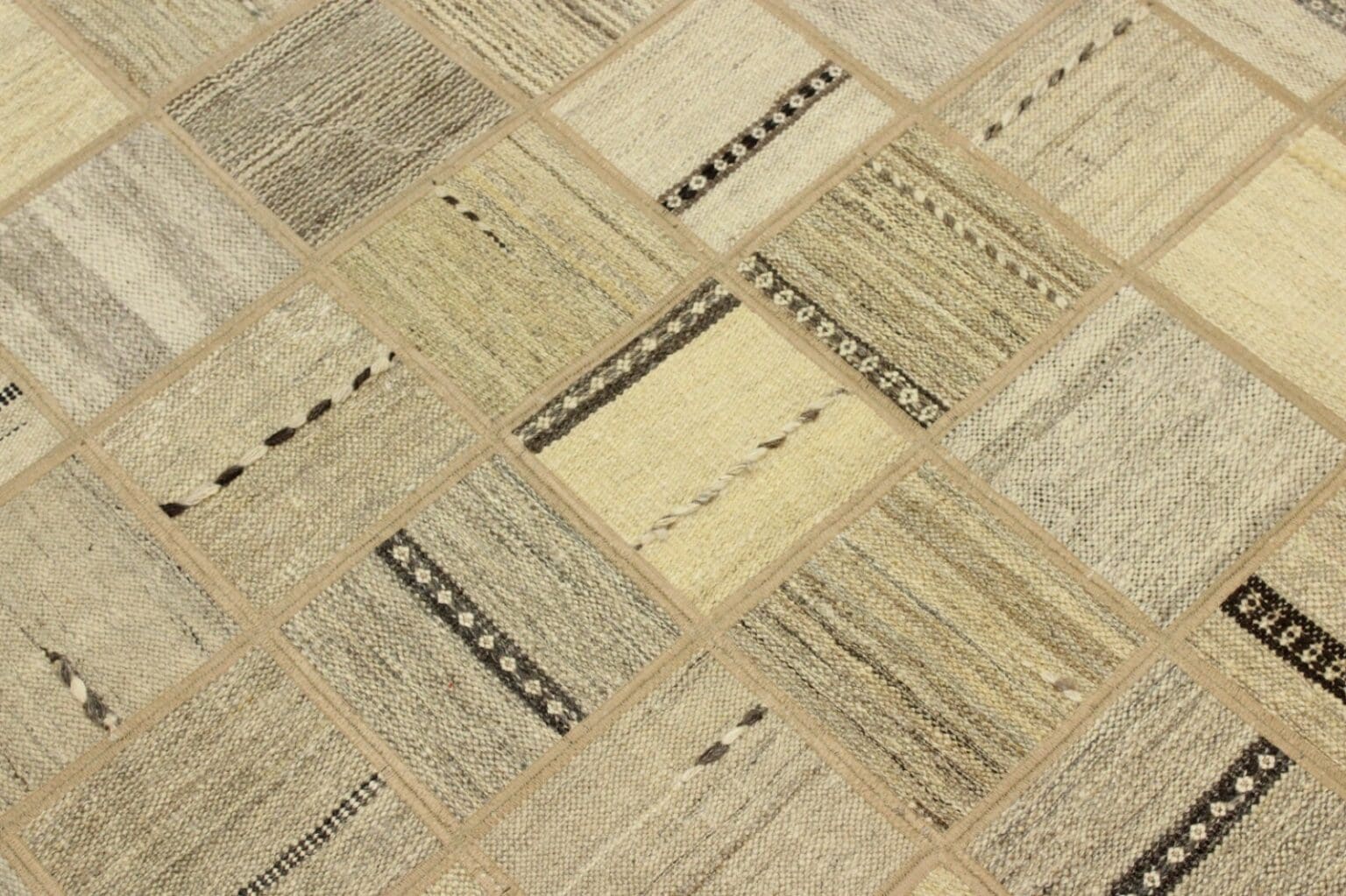
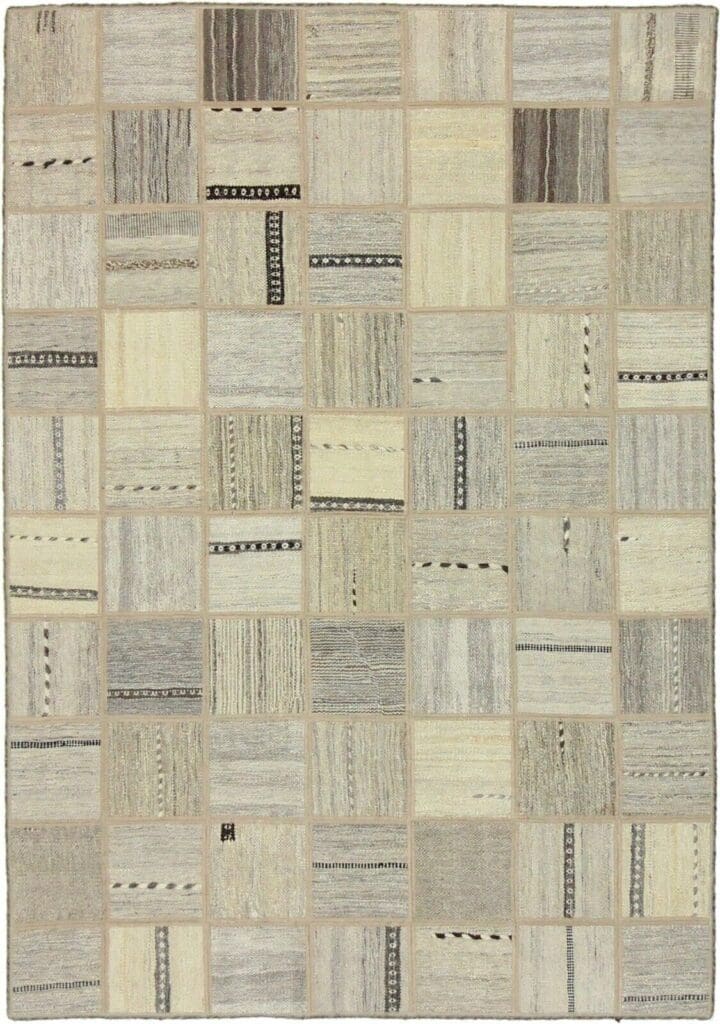
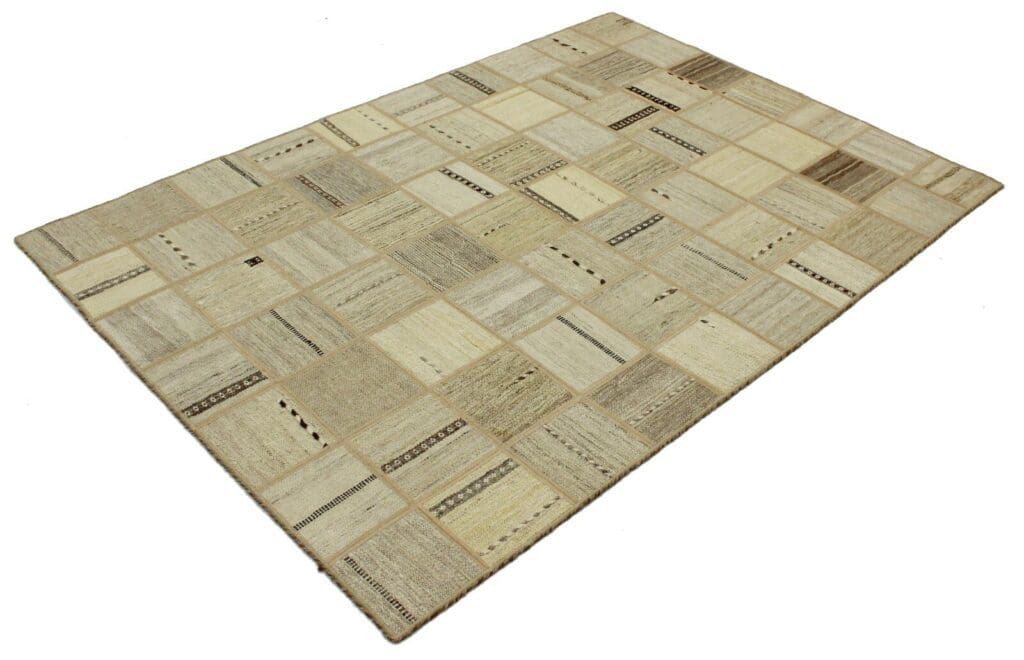
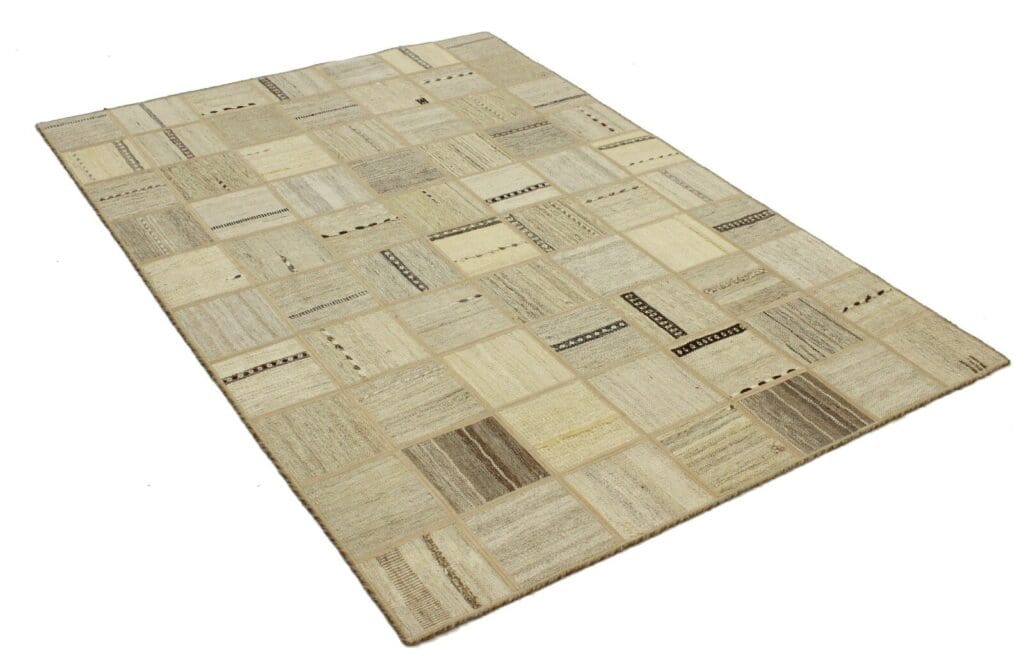
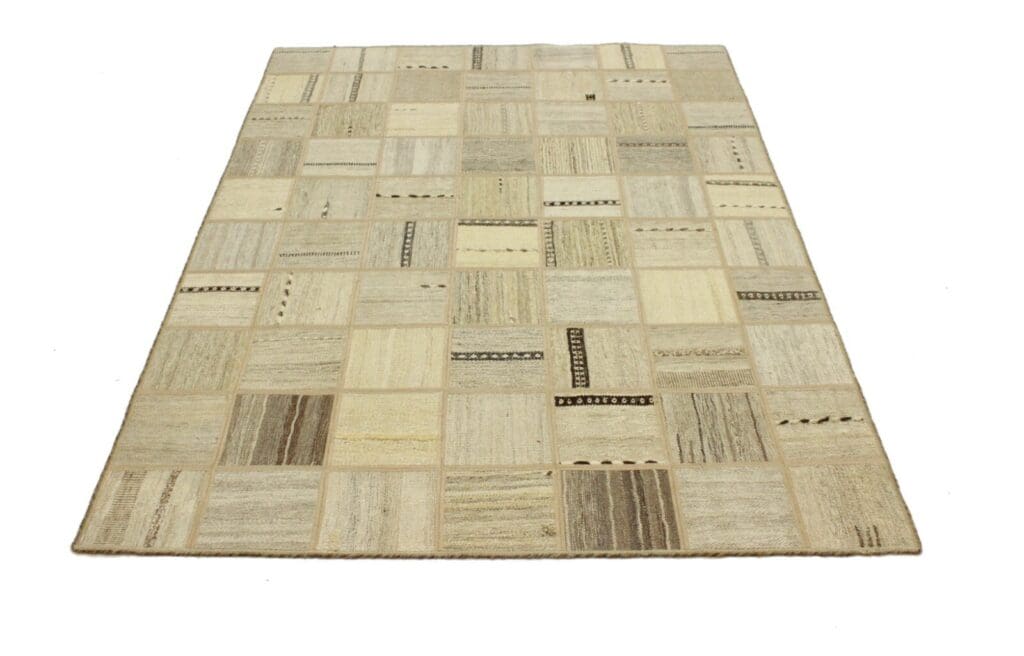
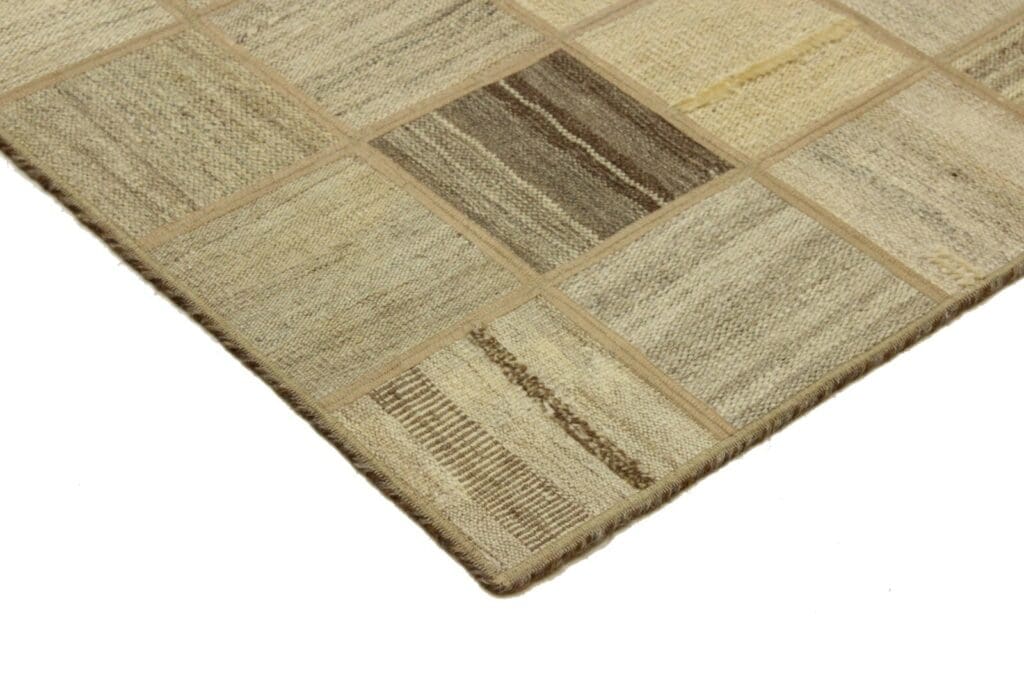
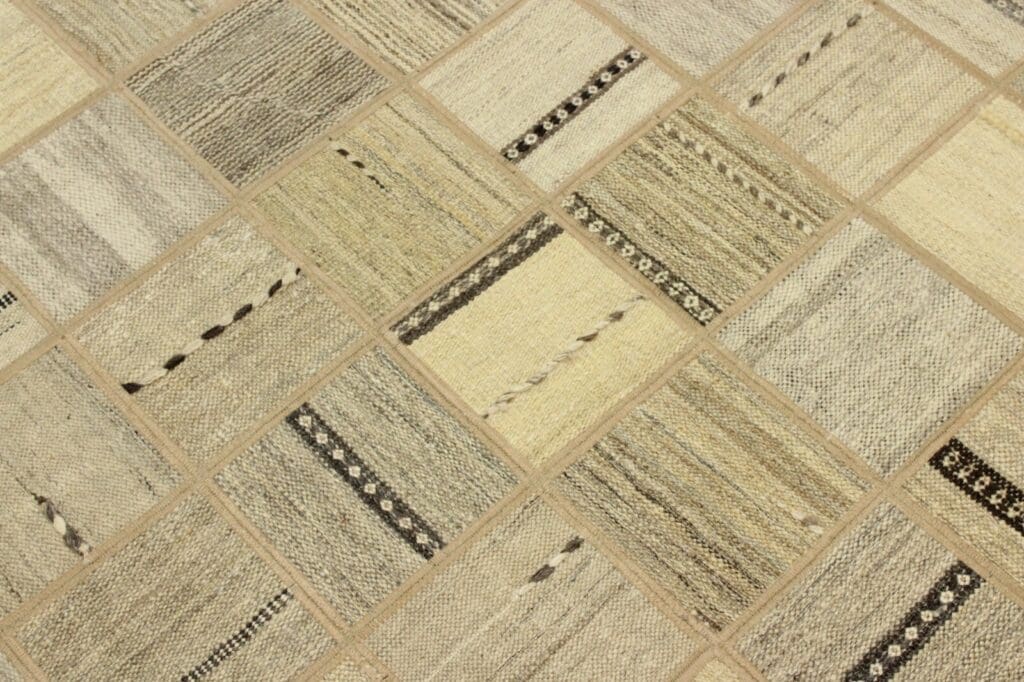
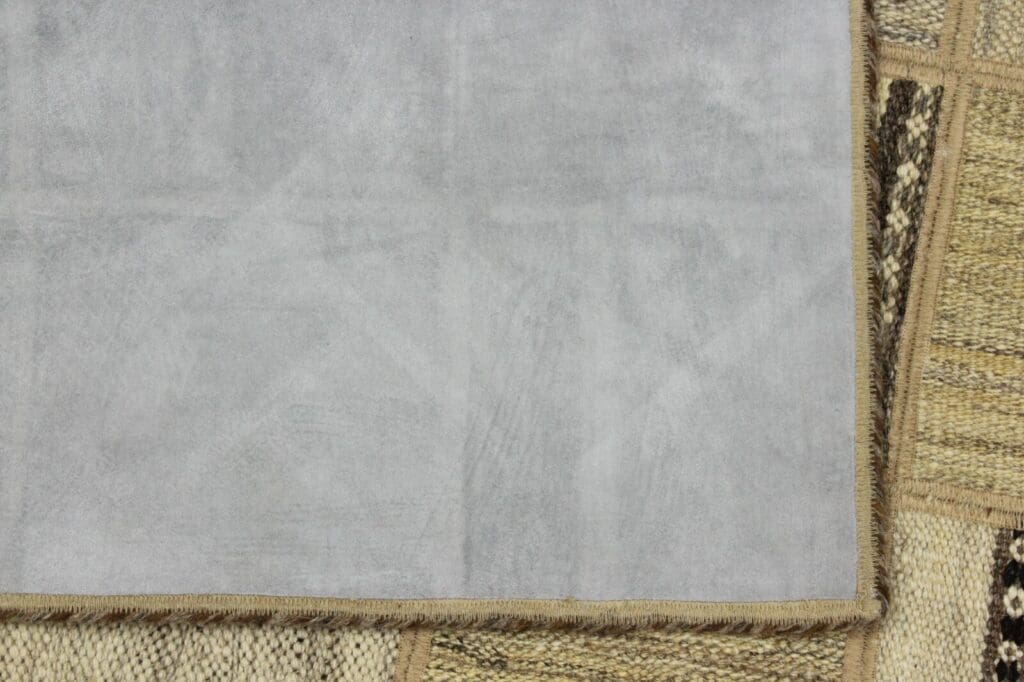
The documented design is a modern patchwork. Patchwork refers to a composition built from multiple sections or visual fields that are brought together as a larger whole. In textile work, those sections may be distinguished by changes in colour, motif, direction, scale or surface. The exact arrangement of this individual rug is not described in further detail, so no particular medallion, border, floral element, geometric figure or colour combination is attributed to it here.
Patchwork designs can be understood as an arrangement of parts rather than as one uninterrupted field. A composition may use blocks, panels or irregular divisions, with each section contributing to the rhythm of the complete surface. The seams or transitions between areas can become part of the design language. In a woven textile, this visual structure may echo the practical logic of assembling smaller pieces, while a contemporary version can use the same principle as an intentional graphic device.
Kelim patterns traditionally make extensive use of geometry because the interlacing method naturally supports angular contours, stepped outlines and repeated forms. Diagonal lines are often built through incremental changes in the placement of the weft, while narrow bands and blocks can be organised into borders or internal divisions. This does not mean that every Kelim has the same motifs. Regional practice, the weaver’s plan and the intended use all affect the final pattern.
Modern patchwork Kelims can place greater emphasis on contrast between sections and on the relationship of one panel to the next. Traditional references may be simplified, enlarged, interrupted or combined with unornamented areas. The design can therefore be read at two levels: as a flat-woven textile with a recognisable technical structure and as a composed surface made from distinct visual units. For this rug, the reliable pattern description remains modern patchwork, without assigning additional motifs that are not recorded.
Special Features
The special characteristics documented for this piece are its hand-woven construction, its Kelim technique and its modern patchwork design. These three descriptions belong together: the technique identifies a flat-woven textile, while the pattern designation describes the contemporary arrangement of its surface. The combination distinguishes it from a hand-knotted pile rug and from a machine-made floor covering, without requiring assumptions about fibre, origin, age or condition.
Patchwork also gives the design a constructed, section-based character. Rather than relying on one continuous pattern field, the visual concept is based on the relationship between individual parts. In a Kelim, that idea is compatible with the direct and graphic quality often associated with flat weaving. The piece is presented as a one-off rug, so its particular arrangement is treated as the individual expression of this documented design rather than as a repeatable standard model.
FAQ
What kind of rug is this?
This is a hand-woven Oriental rug made as a Kelim. It is not described as a hand-knotted pile rug. The documented design is modern patchwork, meaning that the surface is organised as a composition of separate or visually distinct sections. The product information does not identify a province, country of manufacture, fibre composition, knot density, age or condition, so those details are not added to the description.
What does modern patchwork mean in a Kelim?
Modern patchwork describes the way the design is arranged. Instead of presenting one uninterrupted field, the composition brings together multiple sections or visual areas into a unified surface. In a Kelim, this arrangement is combined with flat weaving, where the visible textile is formed by interlaced warp and weft rather than by a raised pile of individually knotted tufts. The precise motifs and colours of this rug are not specified beyond the modern patchwork designation.
How is a hand-woven Kelim different from a hand-knotted rug?
A hand-woven Kelim is constructed by interlacing threads on a loom to create a flat textile. A hand-knotted rug is built by tying individual knots around the foundation and then forming a pile surface. These methods produce different structures and surface qualities. This piece is identified as hand-woven and as a Kelim, so its description follows the flat-weaving tradition. No claim about a particular fibre, density, origin or care requirement is made because those details are not given for this rug.
To provide the best experiences, we use technologies like cookies to store and/or access device information. Consenting to these technologies will allow us to process data such as browsing behavior or unique IDs on this site. Not consenting or withdrawing consent, may adversely affect certain features and functions.
Functional Always active
The technical storage or access is strictly necessary for the legitimate purpose of enabling the use of a specific service explicitly requested by the subscriber or user, or for the sole purpose of carrying out the transmission of a communication over an electronic communications network.
Preferences
The technical storage or access is necessary for the legitimate purpose of storing preferences that are not requested by the subscriber or user.
Statistics
The technical storage or access that is used exclusively for statistical purposes.The technical storage or access that is used exclusively for anonymous statistical purposes. Without a subpoena, voluntary compliance on the part of your Internet Service Provider, or additional records from a third party, information stored or retrieved for this purpose alone cannot usually be used to identify you.
Marketing
The technical storage or access is required to create user profiles to send advertising, or to track the user on a website or across several websites for similar marketing purposes.
 SECURE PAYMENT
 SHIPPING PARTNERS


