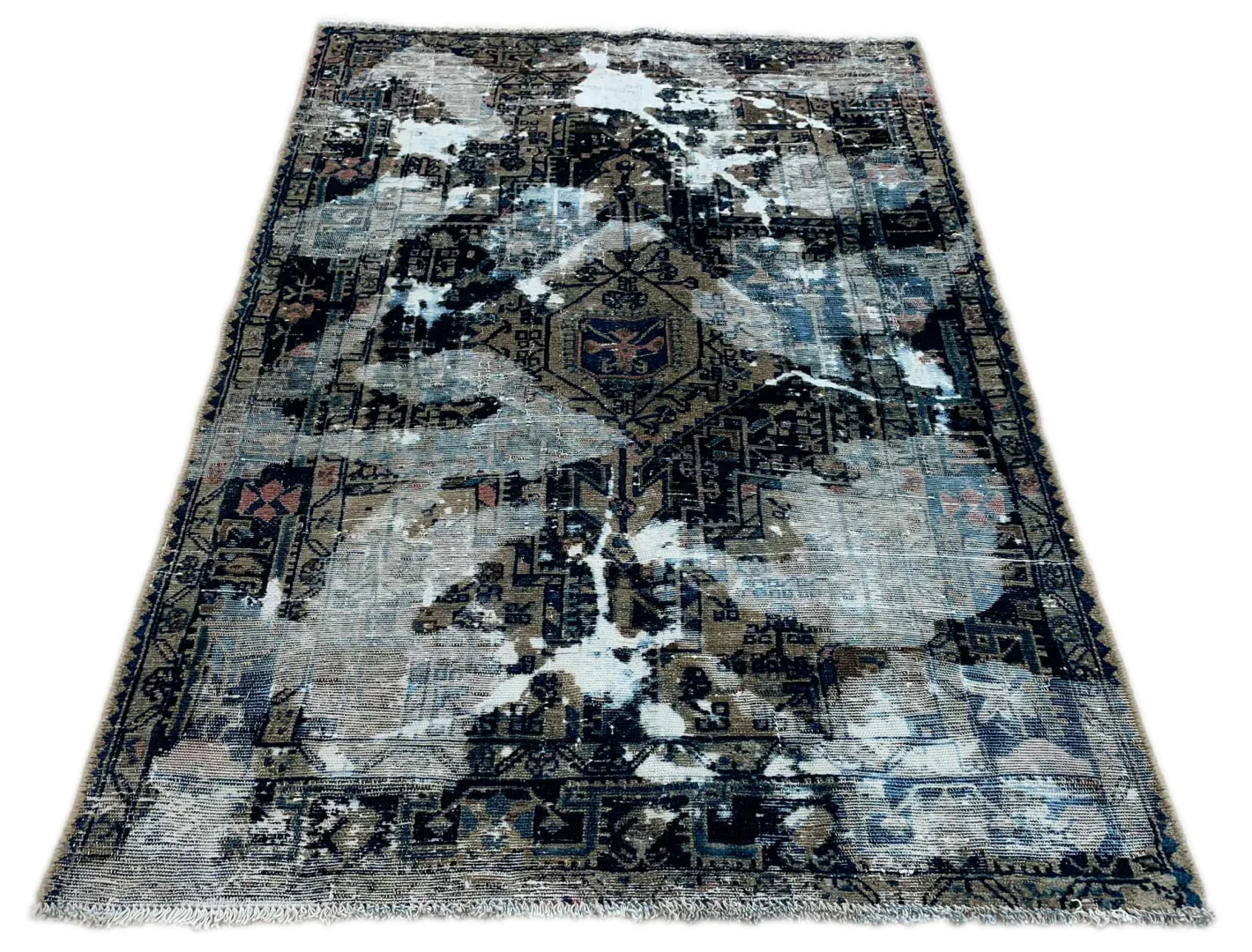
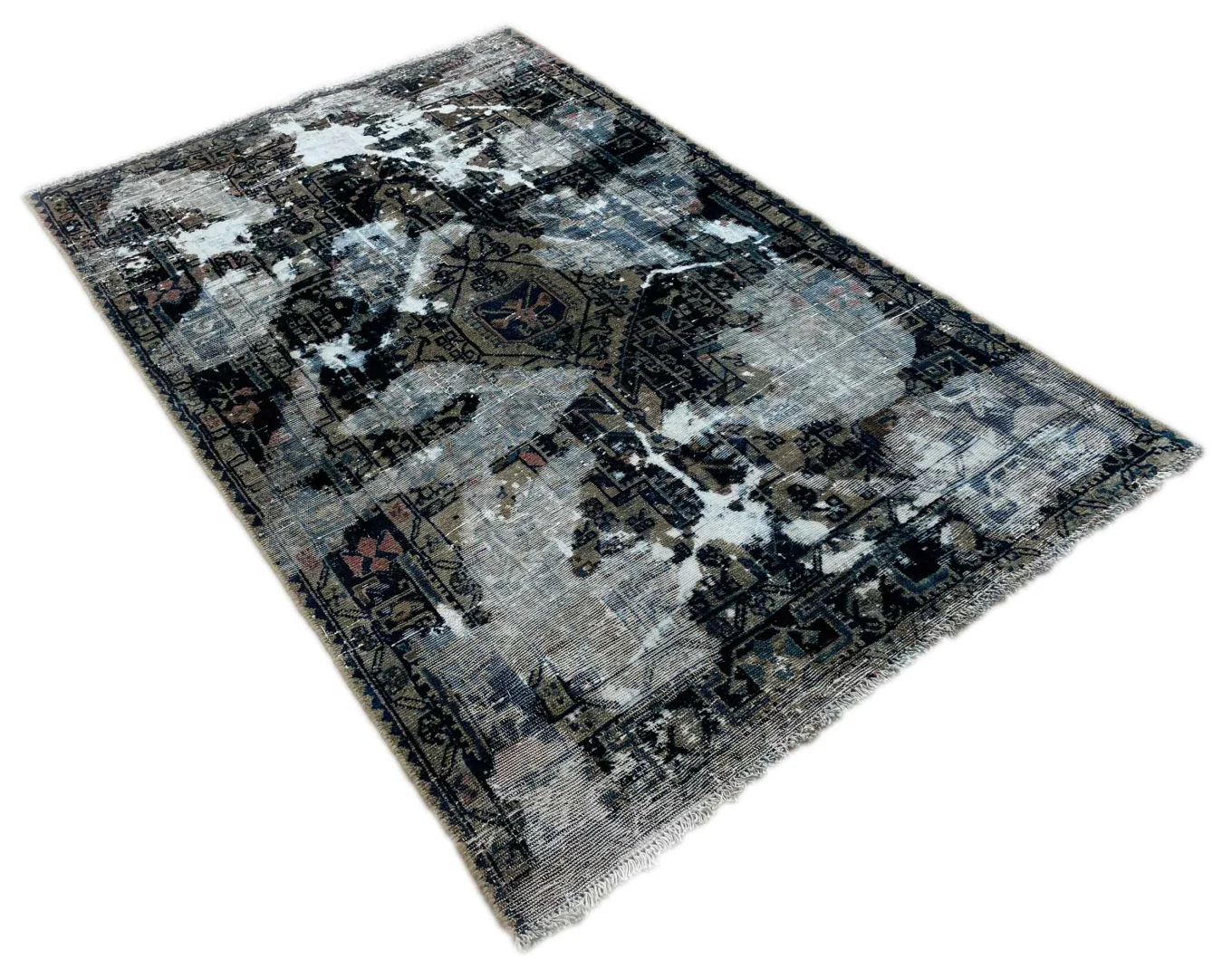
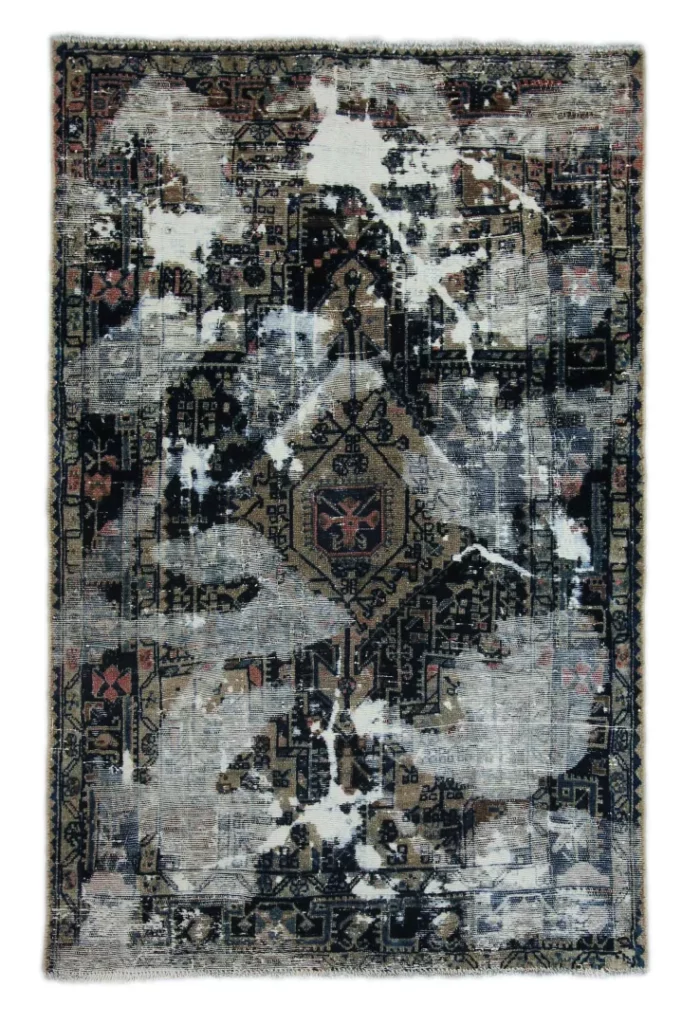
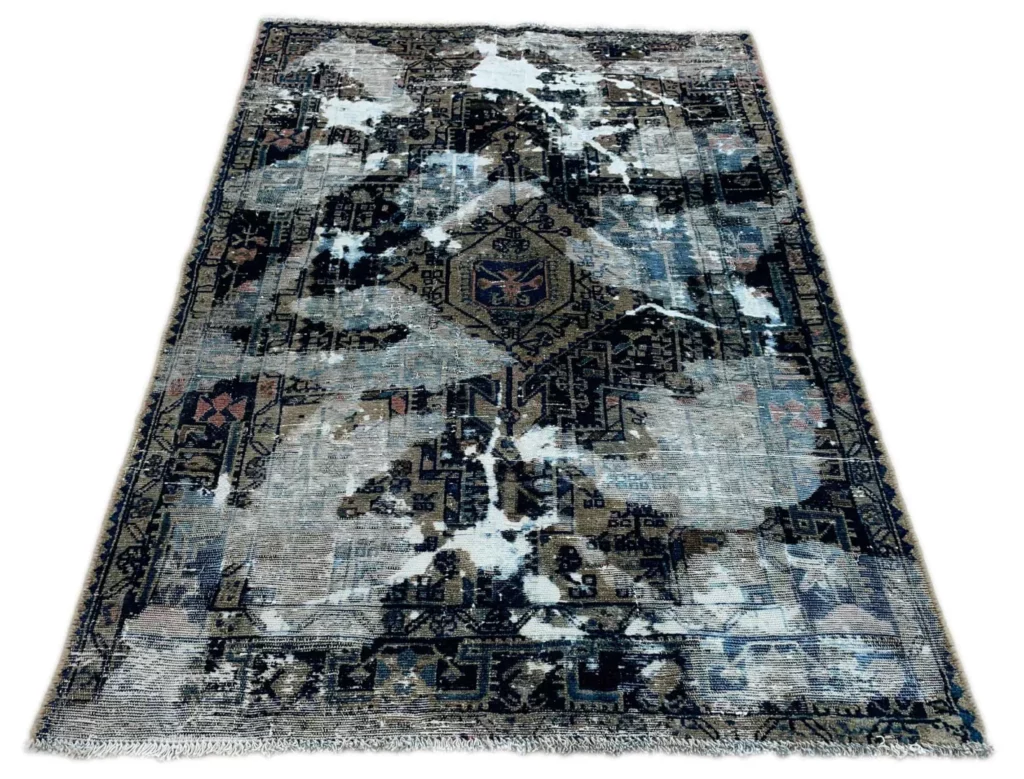
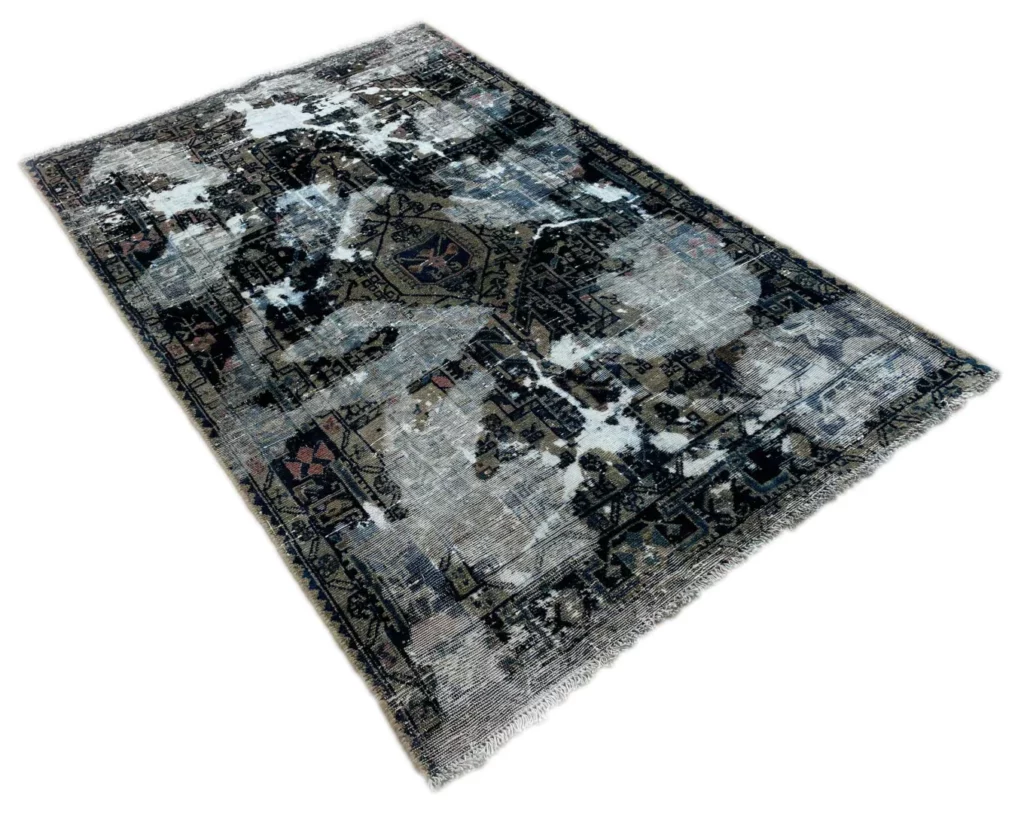
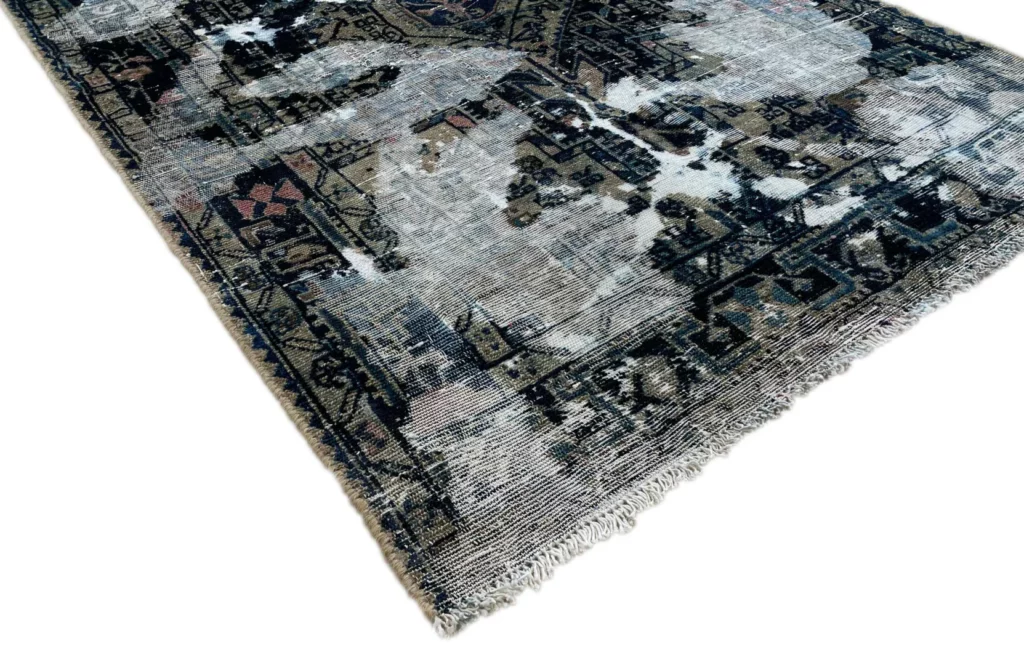
Hand-knotted Oriental rug | Material: Wool pile | Size: 177 x 115 cm | Pattern: Modern design with a classic Oriental rug character | Condition: Carefully restored
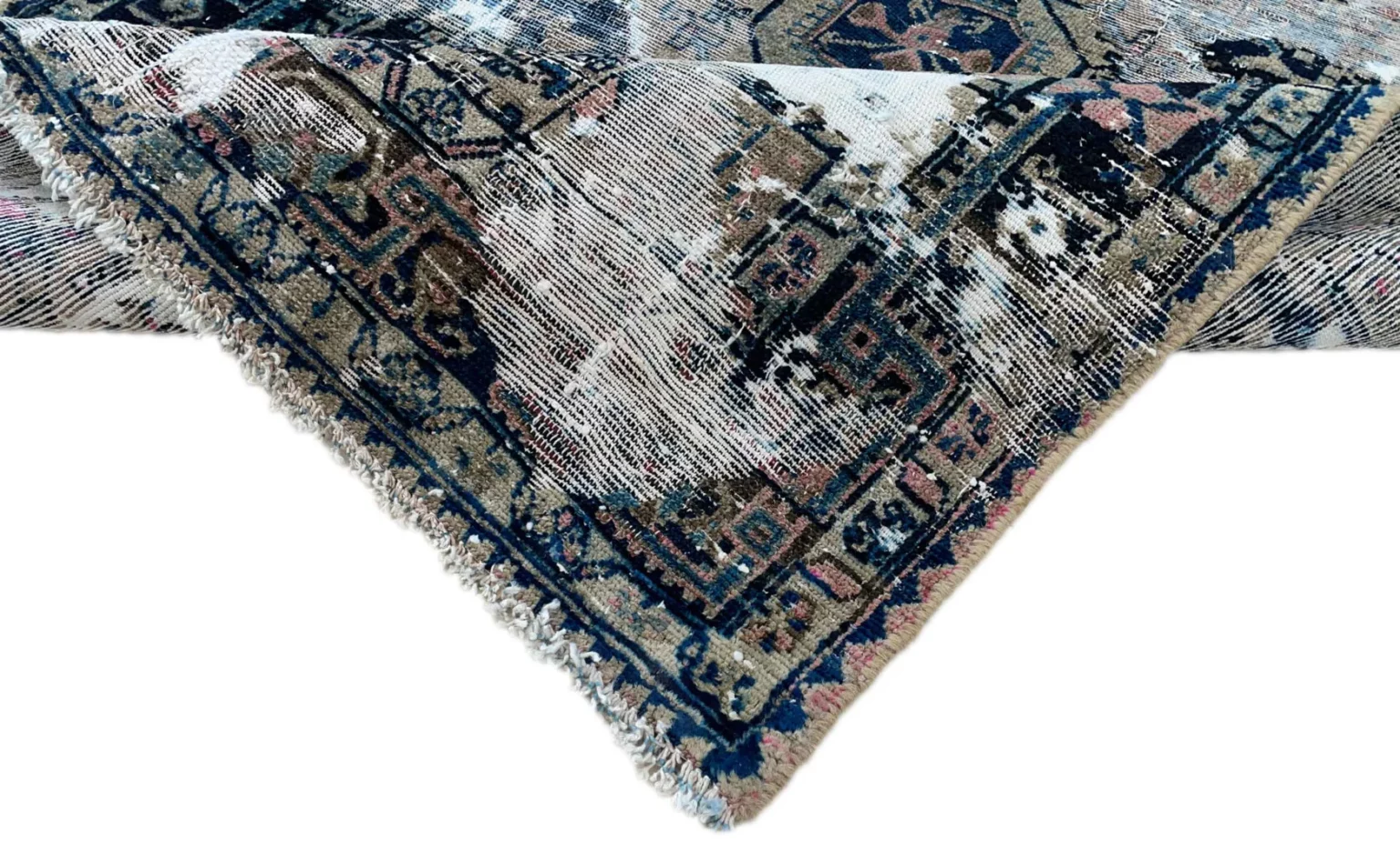
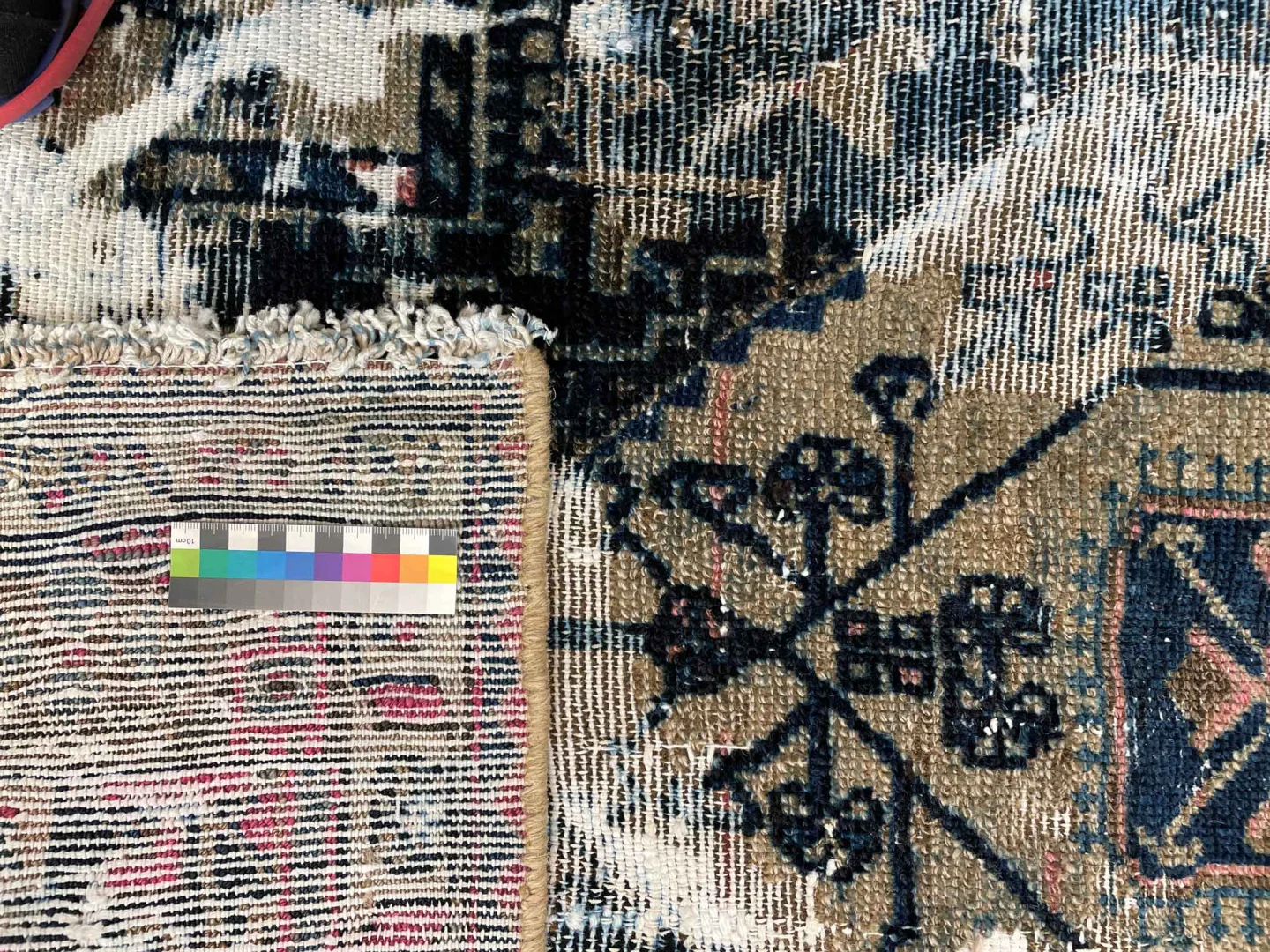
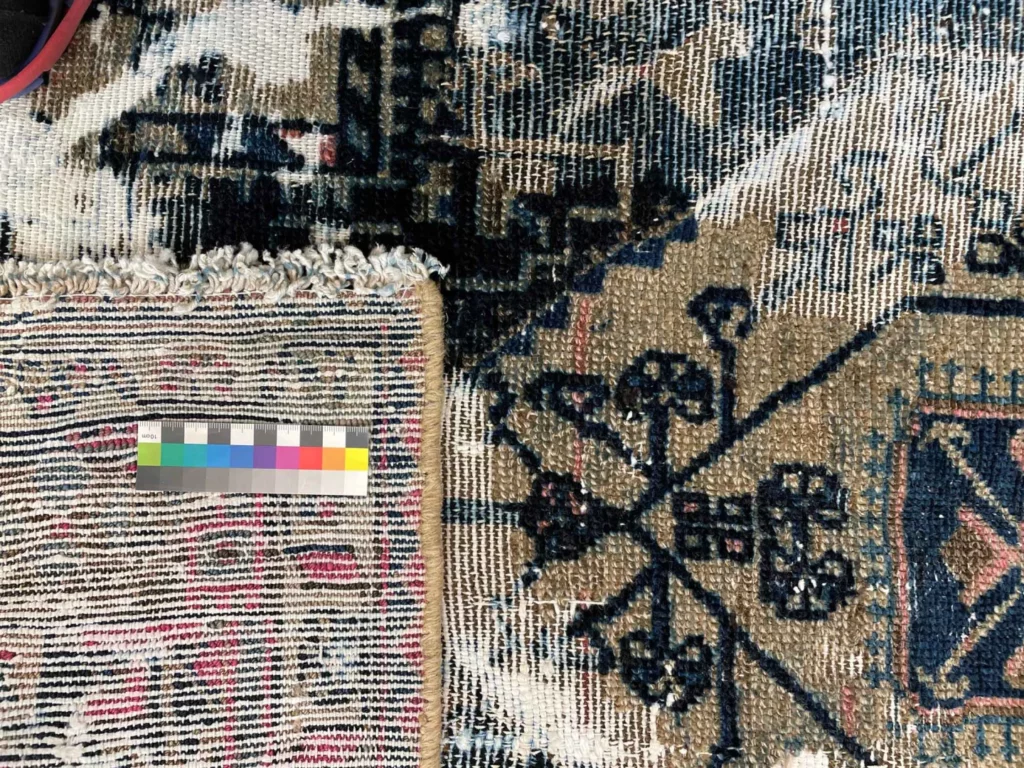
This Oriental rug is hand-knotted and has a pile made from high-quality wool. In hand-knotting, each knot is inserted into the foundation by hand. The textile surface is therefore built gradually on the loom rather than produced by mechanically repeating a complete pattern. Knots, warp threads and weft threads work together to form the structure of the rug. After knotting, the pile is commonly sheared so that the surface has either an even height or a deliberately varied finish.
Wool has been used in oriental rug making for centuries. As a natural fibre, it can be spun, dyed and worked into a resilient pile. Its feel and appearance are influenced by fibre quality, yarn thickness, twist, dyeing and shearing. High-quality wool can combine a soft handle with a durable surface. High-quality wool is specified as the pile material of this piece. The description does not state what material was used for the warp, so no warp material is added.
Hand-knotting involves many separate stages of work. The warp threads are first stretched on the loom. Knots and wefts are then introduced in a repeating sequence until the intended textile field has been built. Shearing, washing, stretching and edging follow according to the method used. These processes influence the surface, stability and clarity of the design. The individual nature of this process is one of the defining features of a hand-knotted rug.
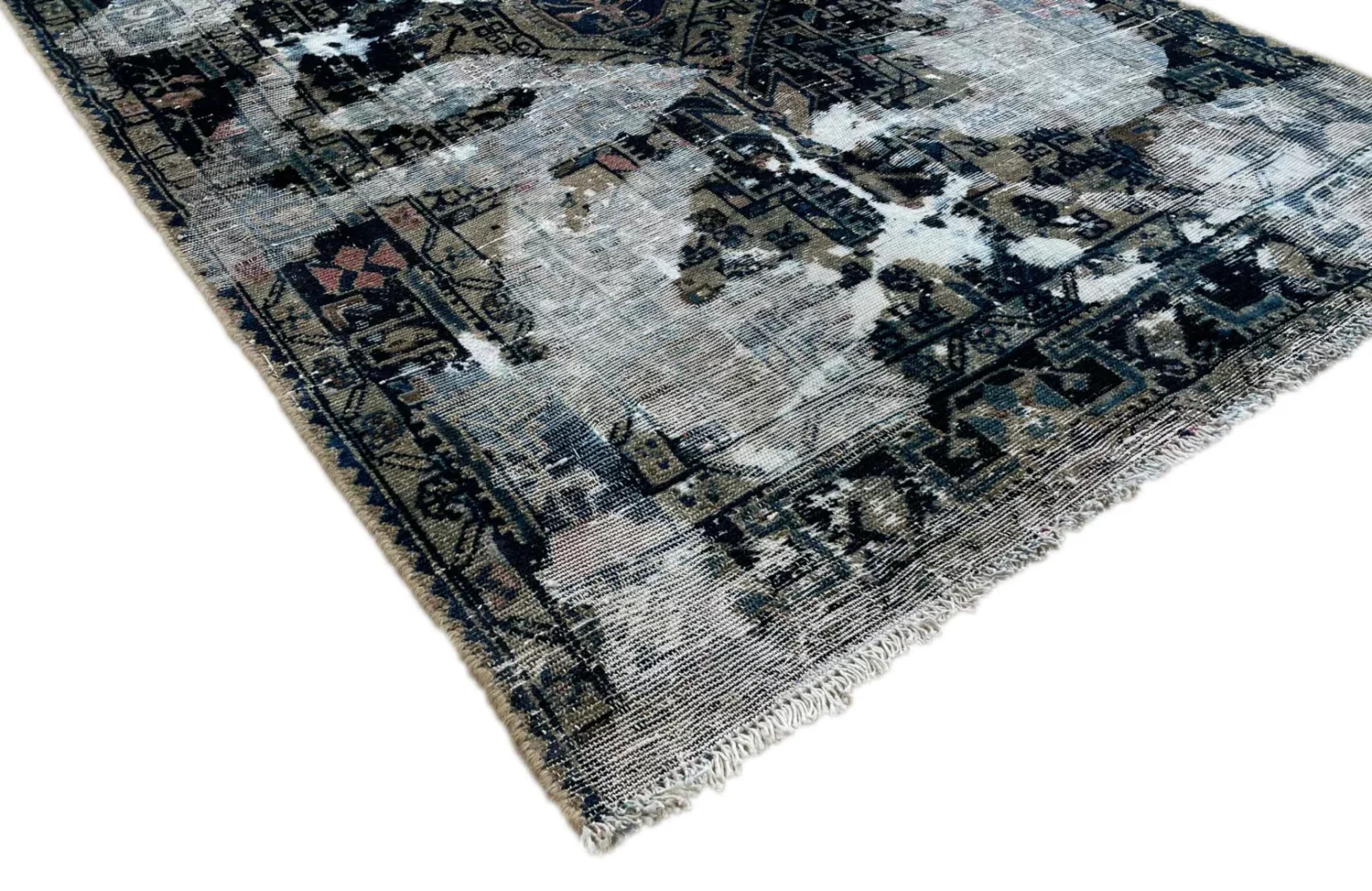
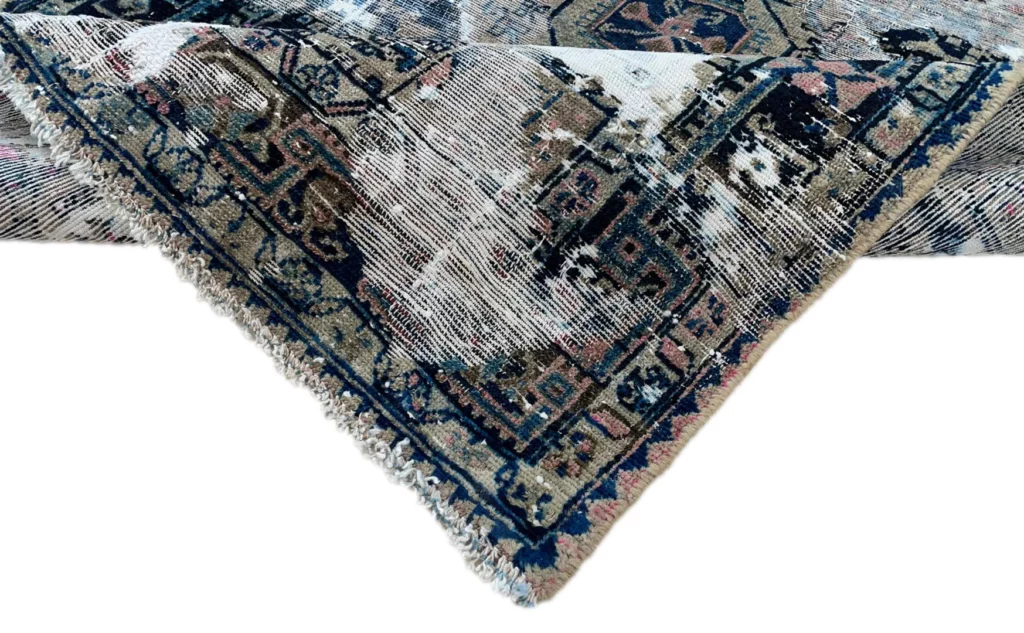
The condition of this rug is described as carefully restored. With a vintage rug, restoration can organise the existing surface and prepare it for contemporary use. It can bring an older textile structure together with a changed visual effect. Restoration does not replace the original knotting method; it works on the appearance and condition of the existing rug. No further technical details about the restoration of this individual piece are provided.
Origin and Tradition
Oriental rugs belong to a broad family of handmade textiles produced in different weaving and knotting regions. The term describes a craft and cultural tradition, not automatically one particular city or province. Individual regions developed their own methods of knotting, colour arrangement, pattern structure and finishing. This is why rugs made according to related principles can have very different visual identities.
Persian rugs form an important part of the history of oriental rugs. They originate in Iran and are known for a craft tradition refined over many centuries. Iranian workshops passed knowledge of spinning, dyeing, knotting, shearing, washing and edging from one generation to the next. The term Persian rug therefore refers to a particular combination of origin and workmanship. This piece is described as an Oriental rug; no specific province or city is given for it.
Traditional production begins with the warp, which is stretched on the loom and forms the supporting framework. Knots are tied around the warp and secured with weft threads. Row by row, this process creates the textile surface. Knot forms, knot arrangement, weft handling and finishing vary between regional techniques. Once the knotting is complete, the pile is worked, washed and stretched. Fringes and side edges are also finished as part of the craft process.
Places such as Isfahan, Tabriz and Kashan are associated with established Persian rug traditions. Isfahan is often linked with finely organised floral compositions, medallions and carefully controlled ornament. Tabriz is known for a wide range of designs, including medallion, garden and figurative compositions. Kashan is likewise associated with floral patterns and clearly structured fields. These examples illustrate the regional variety of Persian rugs, but they do not identify this individual rug as coming from any of those places.
The history of oriental rugs also includes flat-woven Kelims. A Kilim is made by weaving rather than by forming a cut pile, so its surface differs technically from that of a knotted rug. Gabbeh rugs are often associated with simplified forms, reduced ornament and a direct visual language. Nain and Heriz are also recognised as established rug traditions, each with its own approaches to pattern and colour. These are examples from the wider textile history and do not constitute an origin statement for this piece.
Oriental rug making has involved both workshop production and knowledge handed down through families and regional communities. Raw fibres are prepared, yarns are dyed and designs are transferred to the loom. The work combines practical experience with control of proportion, rhythm and colour over a broad textile field. In a hand-knotted one-off rug, the making process is therefore not reduced to a single industrial operation. It represents a sequence of skilled textile tasks carried out over time.
Design and Pattern
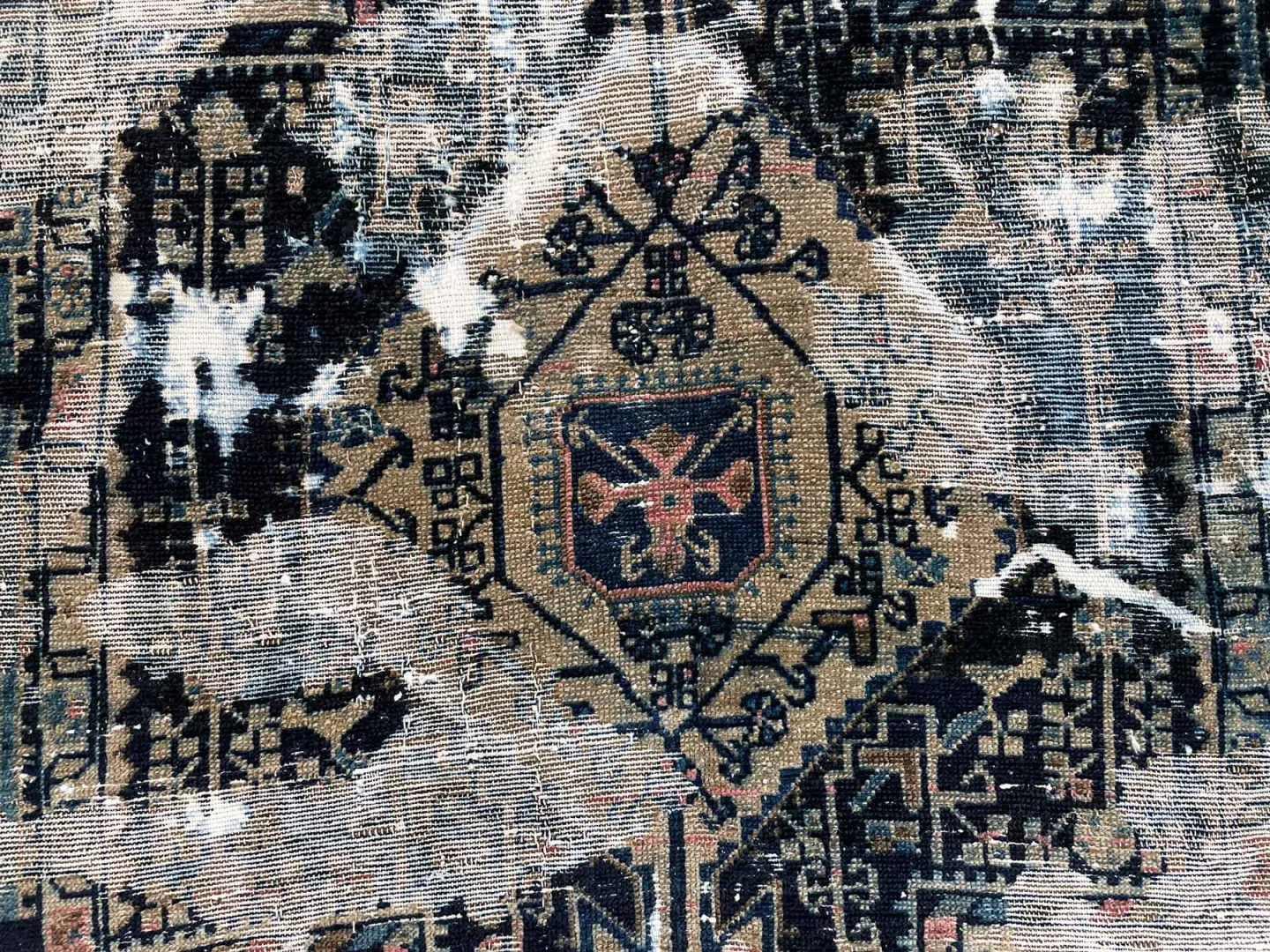
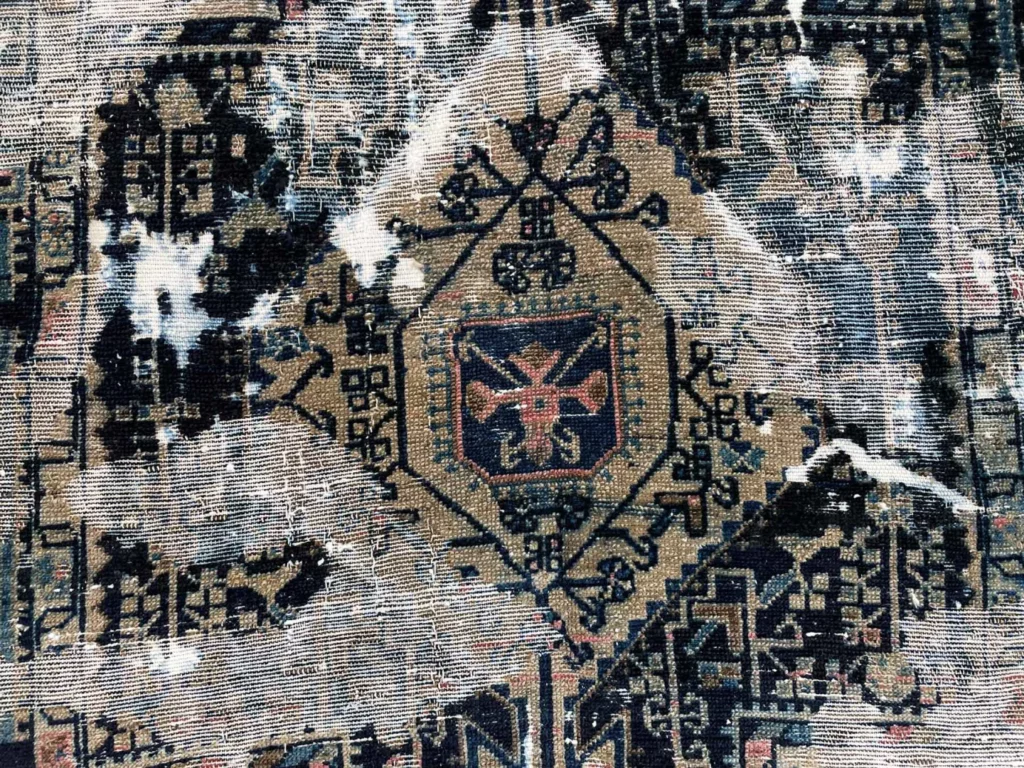
The pattern of this rug is described as a modern design with a classic Oriental rug character. It combines a contemporary overall appearance with a visual vocabulary associated with traditional oriental rugs. No specific border, medallion, field arrangement, colours or individual motifs are stated for this piece. Its design can therefore be described only by the combination expressly given: modern styling and a classic Oriental rug character.
Traditional oriental rug designs often organise the surface through a relationship between a central field, border areas and transitional zones. A field may contain a central medallion or may be covered with vines, blossoms and geometric ornaments. A border frames the composition and can carry its own repeating pattern. Other designs avoid a strict central axis and distribute motifs across the entire field. Symmetry, repetition and measured spacing help establish order and rhythm.
Common motifs in oriental textile art include stylised leaves, flowers, vines, rosettes and branches. Geometric shapes may appear as independent ornaments or may structure floral elements. Animal, human and garden imagery also belongs to particular historical design families. Regional traditions stylised and arranged these motifs in different ways. They could be used decoratively, symbolically or narratively. General knowledge of these motifs does not establish that any particular one is present on this rug.
A modern design may simplify inherited principles, reduce individual ornaments or create a more open treatment of the field. It may also arrange familiar forms with less formal symmetry. With vintage rugs, this can create a dialogue between an older handmade foundation and a later visual treatment. When the pile of an older rug is shortened or dyed, the pattern may appear flatter and the colour effect may differ from its earlier appearance. These processes are part of the general treatment of vintage Persian rugs.
The visual effect of a rug depends on more than its motifs. Knot density, pile height, shearing, colour distribution and lighting all influence how clearly an ornament can be seen. A dense construction can support fine drawing, while larger forms remain legible in a more reduced composition. Natural dyes are often used in traditional rugs to create nuanced and lasting colours. As colours age, they can develop a particular patina. No specific colours or motifs are stated for this rug.
The classic Oriental rug character may be expressed through overall arrangement, ornamental references or the visibly handmade surface. The modern design can also make such a rug compatible with contemporary interiors. Modern styling does not have to abandon historical design language; it can give traditional elements a different balance and emphasis. For this piece, the defined design feature is the stated combination of modern design and classic Oriental rug character.
Special Features
The stated features of this one-off rug are its hand-knotted construction, high-quality wool pile, careful restoration and the combination of modern design with a classic Oriental rug character. The vintage description refers to its restored appearance and the character of an older rug. No particular origin, knot density, warp quality, colour palette or date is provided, so none of these details is added.
Vintage rugs form a distinct group within the wider world of oriental rugs. Older examples may have their pile shortened and dyed in order to create a more modern surface while retaining the traditional character of the design. Appropriate care supports the preservation of material and structure. Recommended care includes regular vacuuming without a brush attachment, avoiding direct sunlight and occasional professional cleaning.
FAQ
How should I care for a hand-knotted Oriental rug?
Regular vacuuming without a brush attachment removes loose dirt while avoiding unnecessary stress on the pile. Direct sunlight should be avoided because prolonged exposure can alter a rug’s colour effect over time. Occasional professional cleaning by a specialist helps preserve colour and structure in the long term. For a carefully restored vintage rug, gentle professional treatment is especially appropriate, since the surface should not be exposed to unsuitable cleaning agents or aggressive brushing.
How can the quality of a hand-knotted rug be assessed?
The quality of a hand-knotted rug is commonly considered through its knot count per square metre, the materials used and the density of the pile. A high knot count may indicate finer and more time-consuming workmanship. It should, however, be assessed together with fibre quality, evenness of execution, pile structure and the construction as a whole. Fine wool or silk are traditionally associated with high-quality rugs. High-quality wool is specified as the pile material of this rug; its knot density is not stated.
What are the advantages of a hand-knotted Oriental rug?
A hand-knotted Oriental rug has an individually built structure and a distinct textile appearance. When properly maintained, natural materials can support a long service life. In a vintage piece, the combination of a restored surface and traditional knotting adds another aspect to its character. Each one-off rug can convey its own history of making and later treatment. For this rug, the explicitly described features are hand-knotting, high-quality wool, careful restoration and a modern design with a classic Oriental rug character.
To provide the best experiences, we use technologies like cookies to store and/or access device information. Consenting to these technologies will allow us to process data such as browsing behavior or unique IDs on this site. Not consenting or withdrawing consent, may adversely affect certain features and functions.
Functional Always active
The technical storage or access is strictly necessary for the legitimate purpose of enabling the use of a specific service explicitly requested by the subscriber or user, or for the sole purpose of carrying out the transmission of a communication over an electronic communications network.
Preferences
The technical storage or access is necessary for the legitimate purpose of storing preferences that are not requested by the subscriber or user.
Statistics
The technical storage or access that is used exclusively for statistical purposes.The technical storage or access that is used exclusively for anonymous statistical purposes. Without a subpoena, voluntary compliance on the part of your Internet Service Provider, or additional records from a third party, information stored or retrieved for this purpose alone cannot usually be used to identify you.
Marketing
The technical storage or access is required to create user profiles to send advertising, or to track the user on a website or across several websites for similar marketing purposes.

 SECURE PAYMENT
 SHIPPING PARTNERS


